
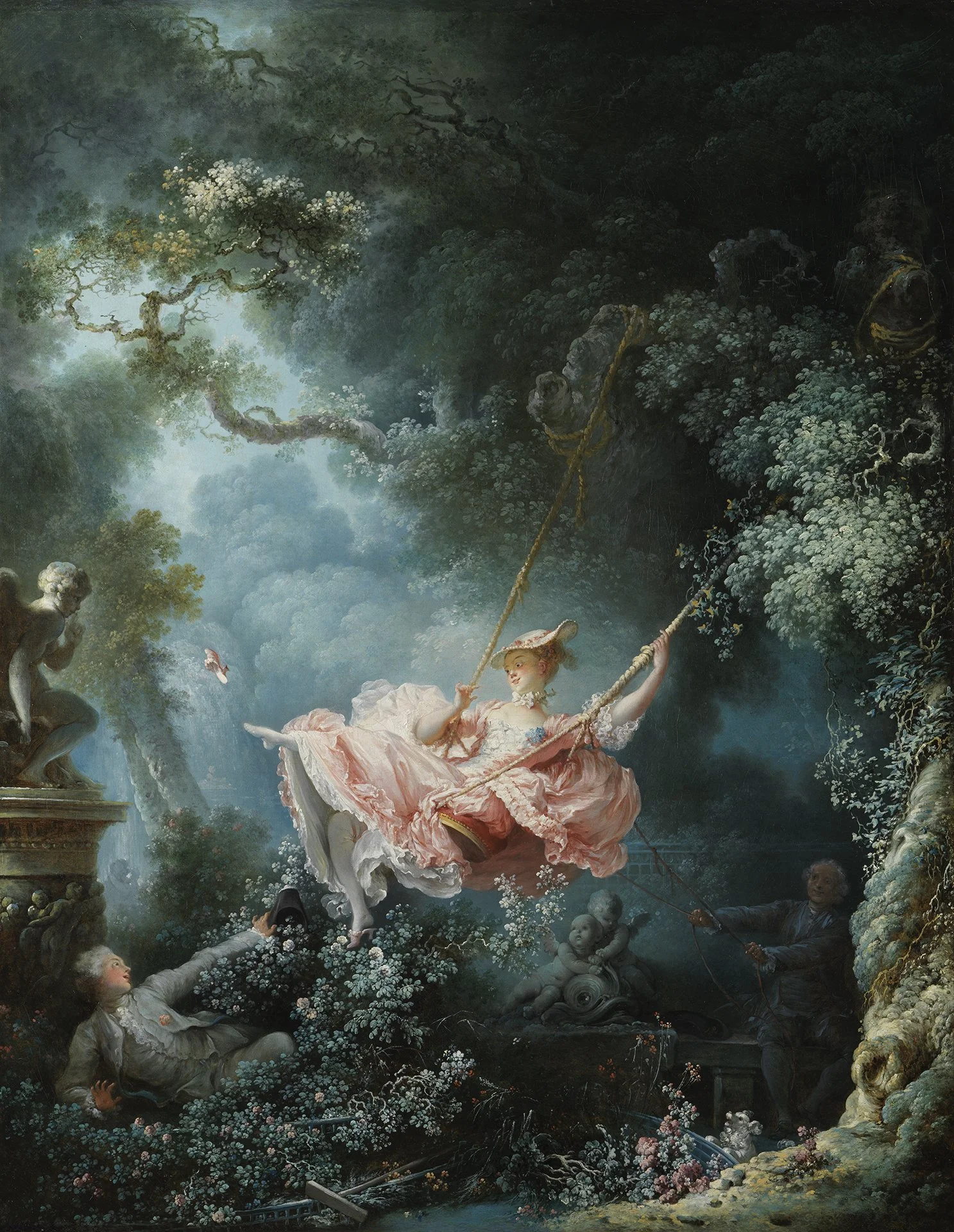
The Swing
JEAN-HONORÉ FRAGONARD
Derided for its frivolity, ‘The Swing’ came to represent the best and worst aspects of 18th Century French High Society. Philosophers of the Enlightenment saw the painting, a masterpiece of Rococo, as emblematic of the rotten core of the whole era - extravagant wealth concerning itself with eroticism and playfulness, existing in a fantasy world removed from reason, rationality and truth. Yet ‘The Swing’ has persisted as a great work for these reasons and more. An aristocratic woman is pushed on a swing, her shoe flying off her feet in exuberant ecstasy, as her lover hides in the bushes below, glimpsing up her dress with each swing. It is lewd and risqué, the two figures playing an illicit sexual game as a statue of Cupid keeps their secret. The lush garden unfolds behind them into impossibility, and the world is soaked in soft erotic light. It is as close to “let them eat cake” as a painting has ever come.
Jean-Honoré Fragonard
JEAN-HONORÉ FRAGONARD, 1767, OIL ON CANVAS.
Derided for its frivolity, ‘The Swing’ came to represent the best and worst aspects of 18th Century French High Society. Philosophers of the Enlightenment saw the painting, a masterpiece of Rococo, as emblematic of the rotten core of the whole era - extravagant wealth concerning itself with eroticism and playfulness, existing in a fantasy world removed from reason, rationality and truth. Yet ‘The Swing’ has persisted as a great work for these reasons and more. An aristocratic woman is pushed on a swing, her shoe flying off her feet in exuberant ecstasy, as her lover hides in the bushes below, glimpsing up her dress with each swing. It is lewd and risqué, the two figures playing an illicit sexual game as a statue of Cupid keeps their secret. The lush garden unfolds behind them into impossibility, and the world is soaked in soft erotic light. It is as close to “let them eat cake” as a painting has ever come.

Jack-in-the-Pulpit No. VI
GEORGIA O’KEEFFE
The last painting in her much revered series, O’Keeffe takes the flower to its abstract conclusion. She turns the stigma into a surreal form, the hues of the petals become a expansive background to a winding road. She reduces nature into something formal and emotional, and requires the viewer to read it as they like. “I realized that were I to paint flowers small, no one would look at them because I was unknown.” Said O’Keeffe, “So I thought I'll make them big, like the huge buildings going up. People will be startled; they'll have to look at them - and they did.” When she began her Jack-in-the-Pulpit series, which sees the flowers move across four canvases from reality to abstraction, Georgia O’Keeffe was all but unknown. A female modernist painter in a male dominated world, attempting to carve a name for herself. By the time the series was completed, she had gained reputation and with it, speculation. Every viewer tried to create their own narrative of the artist from her paintings of flowers, casting her as an artist of repression, of longing, of lust, of feminism, of tradition. But O’Keeffe has long defied any easy narrative, she is an artist of America and as broad and complicated as the country she captured, through its abstraction and its reality.
Georgia O’Keeffe
GEORGIA O’KEEFFE, 1930. OIL ON CANVAS.
The last painting in her much revered series, O’Keeffe takes the flower to its abstract conclusion. She turns the stigma into a surreal form, the hues of the petals become a expansive background to a winding road. She reduces nature into something formal and emotional, and requires the viewer to read it as they like. “I realized that were I to paint flowers small, no one would look at them because I was unknown.” Said O’Keeffe, “So I thought I'll make them big, like the huge buildings going up. People will be startled; they'll have to look at them - and they did.” When she began her Jack-in-the-Pulpit series, which sees the flowers move across four canvases from reality to abstraction, Georgia O’Keeffe was all but unknown. A female modernist painter in a male dominated world, attempting to carve a name for herself. By the time the series was completed, she had gained reputation and with it, speculation. Every viewer tried to create their own narrative of the artist from her paintings of flowers, casting her as an artist of repression, of longing, of lust, of feminism, of tradition. But O’Keeffe has long defied any easy narrative, she is an artist of America and as broad and complicated as the country she captured, through its abstraction and its reality.

River Valley
ROY LICHTENSTEIN
Each new art movement offers a new interpretation of the world, a novel way of representing that which we all see slightly differently. In the twentieth century, it seemed that these ways of seeing were never stagnant, each new decade bringing with it multiple, radical new conceptions of existence. For Roy Lichtenstein, one of the great masters of Pop Art in the American 1960s, his interest was in exploring, subverting, and adapting these representations in ways that spoke directly to the contemporary age. His most famous realisation of these ideas comes in his Benday Dot paintings, where he would reproduce panels from comic books or adverts, meticulously painting a mechanical process of reproduction. Yet, later in his life when he began his ‘Landscape Series’, which this painting is from, he began to flatten his influences into kaleidoscopic beauty. His River Valley contains within it decades of different artistic styles and different interpretations of the natural world, from the expressive brushstrokes and painterly hand to the rigorous lines and modern flourishes - it is an homage to art history, and a declaration that though times have changes, all painters are simply trying to find new ways to see the world.
Roy LIchtenstein
ROY LICHTENSTEIN, 1985. OIL AND MAGNA ON CANVAS.
Each new art movement offers a new interpretation of the world, a novel way of representing that which we all see slightly differently. In the twentieth century, it seemed that these ways of seeing were never stagnant, each new decade bringing with it multiple, radical new conceptions of existence. For Roy Lichtenstein, one of the great masters of Pop Art in the American 1960s, his interest was in exploring, subverting, and adapting these representations in ways that spoke directly to the contemporary age. His most famous realisation of these ideas comes in his Benday Dot paintings, where he would reproduce panels from comic books or adverts, meticulously painting a mechanical process of reproduction. Yet, later in his life when he began his ‘Landscape Series’, which this painting is from, he began to flatten his influences into kaleidoscopic beauty. His River Valley contains within it decades of different artistic styles and different interpretations of the natural world, from the expressive brushstrokes and painterly hand to the rigorous lines and modern flourishes - it is an homage to art history, and a declaration that though times have changes, all painters are simply trying to find new ways to see the world.

Noontide in Late May
CHARLES BURCHFIELD
On the back of this painting, Burchfield describes his intentions to "interpret a child’s impression of noon-tide in late May—The heat of the sun streaming down & rosebushes making the air drowsy with their perfume.” This drowsiness is apt, the painting is alive with the intoxication of spring, a scene of vivid imagination seen through sun drenched eyes. Like so many of his contemporaries, Burchfield found nature an exhilarating subject, and painted a series of works depicting the seasons, of which this is one. His intention was not to document the world, but capture the mood of it with a youthful fascination, and recreate his childhood adoration for the gardens he spent many hours in. This work is of his neighbours backyard in Salem, Ohio, and was painted after an unhappy sojourn in New York City. It is perhaps the return to a rural, natural world after the imposing urbanity that charges this painting with such vitality, joy, and exuberance.
Charles Burchfield
CHARLES BURCHFIELD, 1917. WATERCOLOR AND PENCIL ON PAPER.
On the back of this painting, Burchfield describes his intentions to "interpret a child’s impression of noon-tide in late May—The heat of the sun streaming down & rosebushes making the air drowsy with their perfume.” This drowsiness is apt, the painting is alive with the intoxication of spring, a scene of vivid imagination seen through sun drenched eyes. Like so many of his contemporaries, Burchfield found nature an exhilarating subject, and painted a series of works depicting the seasons, of which this is one. His intention was not to document the world, but capture the mood of it with a youthful fascination, and recreate his childhood adoration for the gardens he spent many hours in. This work is of his neighbours backyard in Salem, Ohio, and was painted after an unhappy sojourn in New York City. It is perhaps the return to a rural, natural world after the imposing urbanity that charges this painting with such vitality, joy, and exuberance.

CH22 Chair
HANS WEGNER
Simplicity, functionality, elegance and an influence from nature are the tenets of Danish design. Wegner captures them all in his CH22 Lounge chair. The form pressed back follows the curves of a leaf, while the arm supports seem reminiscent of axe handles and yet the whole thing is so simple, seems so obvious, you hardly notice it’s brilliance. Wegner was prolific, and obsessed with Chairs. He designed over 500 different models in his life, striving for a single perfect seat. Nearly all of these chairs in some way compliment each other, none would look out of place in a room filled with them, but it was never enough for Wegner. ‘If only could design just one good chair in your life,’ he said, ‘but you simply cannot’.
HANS J. WEGNER
HANS J. WEGNER, 1950
Simplicity, functionality, elegance and an influence from nature are the tenets of Danish design. Wegner captures them all in his CH22 Lounge chair. The form pressed back follows the curves of a leaf, while the arm supports seem reminiscent of axe handles and yet the whole thing is so simple, seems so obvious, you hardly notice it’s brilliance. Wegner was prolific, and obsessed with Chairs. He designed over 500 different models in his life, striving for a single perfect seat. Nearly all of these chairs in some way compliment each other, none would look out of place in a room filled with them, but it was never enough for Wegner. ‘If only could design just one good chair in your life,’ he said, ‘but you simply cannot’.

Saint Jerome in His Study
ALBRECHT DÜRER
We are gifted a moment of quiet, at once intimate and grand, and become spectators to a Saint’s contemplation. In the study, Saint Jerome is engrossed at his desk and the objects of his life are laid out around him in use and mess - the ceilings are low and the room looks almost familiar, strangely human. Yet as one looks deeper, impossibility arises. The perspective creates intimacy but positions us as viewing from somewhere unplaceable, and the objects that at first seem to make sense within the room, are revealed to defy laws of physics. Then there is the lion that rests on the floor, next to a dog - a traditional part of Jerome’s iconography teamed with a symbol of domesticity, co-existing together. Dürer draws this duality across the work, perhaps most obviously in the line from Jerome’s glowing halo, through the crucifix, to the skull on the windowsill, with an hourglass positioned above. This is a story in objects, of death and mortality to resurrection, and redemption through belief and prayer.
Albrecht Dürer
ALBRECHT DÜRER, 1514. ENGRAVING
We are gifted a moment of quiet, at once intimate and grand, and become spectators to a Saint’s contemplation. In the study, Saint Jerome is engrossed at his desk and the objects of his life are laid out around him in use and mess - the ceilings are low and the room looks almost familiar, strangely human. Yet as one looks deeper, impossibility arises. The perspective creates intimacy but positions us as viewing from somewhere unplaceable, and the objects that at first seem to make sense within the room, are revealed to defy laws of physics. Then there is the lion that rests on the floor, next to a dog - a traditional part of Jerome’s iconography teamed with a symbol of domesticity, co-existing together. Dürer draws this duality across the work, perhaps most obviously in the line from Jerome’s glowing halo, through the crucifix, to the skull on the windowsill, with an hourglass positioned above. This is a story in objects, of death and mortality to resurrection, and redemption through belief and prayer.

Twin Heads
ALFRED HENRY MAURER
Fusing the composition of Cubist art with the potently affecting feeling of Expressionism, Maurer’s dual heads occupied him for much of his career but it was only in his maturity that they realised their greatest forms. This one, painted just two years before he died from suicide at 64, is haunting. The two female figures become one, though their fusion seems almost unwilling, their eyes filled with trepidation. This uneasy duality was something the artist felt both personally, and in his artistic practice. Maurer began his career painting landscapes in a far more naturalist style, but began to look internally and found within himself a more abstract feeling. “It is impossible to present an exact transcription of nature”, he said, “It is necessary for art to differ from nature. Perhaps art should be an intensification of nature; at least it should express an inherent feeling which cannot be obtained from nature except through a process of association… The artist must be free to paint his effects. Nature must not bind him.”
Alfred Henry Maurer
ALFRED HENRY MAURER, c.1930. OIL ON CANVAS.
Fusing the composition of Cubist art with the potently affecting feeling of Expressionism, Maurer’s dual heads occupied him for much of his career but it was only in his maturity that they realised their greatest forms. This one, painted just two years before he died from suicide at 64, is haunting. The two female figures become one, though their fusion seems almost unwilling, their eyes filled with trepidation. This uneasy duality was something the artist felt both personally, and in his artistic practice. Maurer began his career painting landscapes in a far more naturalist style, but began to look internally and found within himself a more abstract feeling. “It is impossible to present an exact transcription of nature”, he said, “It is necessary for art to differ from nature. Perhaps art should be an intensification of nature; at least it should express an inherent feeling which cannot be obtained from nature except through a process of association… The artist must be free to paint his effects. Nature must not bind him.”
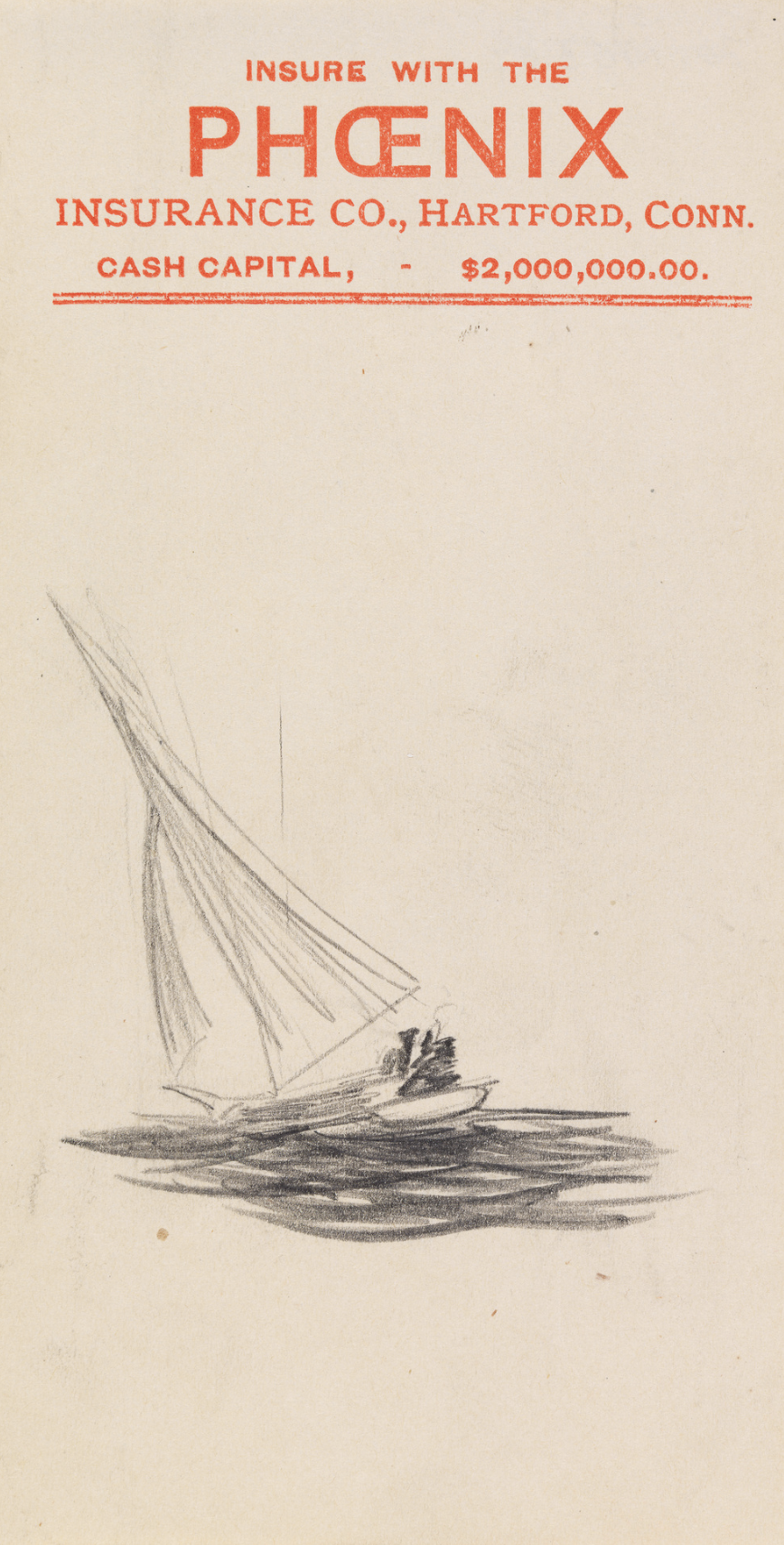
Study of a Sailboat at Sea
EDWARD HOPPER
In city and in countryside, you can find solitude. Loneliness is the pervading emotion of Hopper’s career, whether in the small of the evenings at a counter bar or battling waves against soaring blue skies, his paintings are imbued with a sense of tension between the individual and their environment, and a conflict between tradition and progress. Even in this work, perhaps no more than a simple doodle from a restless mind who expressed himself through gestural strokes, we can find the same ideas at play. Composed of few and determined lines, it’s subject matter is at charming odds with the insurance company letterhead it is drawn on. Hopper could have just have easily done an urban scene, a depiction of solitary business and quiet work that may have made more sense with the corporate medium he chose. Instead, traditional bursts forth - a small sloop sails with gusto, battling against the wind and the dark seas and the bare perceivable outline of three men look towards the horizon, searching for a different world.
James Castle
EDWARD HOPPER, c.1897. GRAPHITE ON PAPER.
In city and in countryside, you can find solitude. Loneliness is the pervading emotion of Hopper’s career, whether in the small of the evenings at a counter bar or battling waves against soaring blue skies, his paintings are imbued with a sense of tension between the individual and their environment, and a conflict between tradition and progress. Even in this work, perhaps no more than a simple doodle from a restless mind who expressed himself through gestural strokes, we can find the same ideas at play. Composed of few and determined lines, it’s subject matter is at charming odds with the insurance company letterhead it is drawn on. Hopper could have just have easily done an urban scene, a depiction of solitary business and quiet work that may have made more sense with the corporate medium he chose. Instead, traditional bursts forth - a small sloop sails with gusto, battling against the wind and the dark seas and the bare perceivable outline of three men look towards the horizon, searching for a different world.

(KOOL)
JAMES CASTLE
In rural Idaho, in the final year of the 19th Century, James Castle was born. Profoundly deaf, he attended school only briefly and never learnt to read, write, or sign properly, he lived a largely uncommunicative life and was only understood by his loving family. Yet, despite his inability to speak or engage with words, Castle had something to say. Developing a sort of charcoal from a mix of soot collected from the fireplace and his own spit, he created hundreds of thousands of artworks using his fingers, sharpened sticks, or peach pits as tools, drawing on found paper and creating books from discarded objects such as this cigarette packet. Unaware of the art world developing around him, his work runs concurrently with the modes and movements across the western world - his own creations often predating mainstream ideas by years. He drew scenes of his domestic existence, of the rural characters he encountered, and the landscape and architecture he loved with an almost photographic memory. He drew across styles, creating works at times naive and abstract and others figurative and exacting - unbeknownst to him, Castle’s mind contained within it an understanding of almost every significant art movement of the 20th century.
James Castle
JAMES CASTLE, c1910-1977. ARTIST’S BOOK WITH SOOT AND SPIIT ON FOUND PAPER.
In rural Idaho, in the final year of the 19th Century, James Castle was born. Profoundly deaf, he attended school only briefly and never learnt to read, write, or sign properly, he lived a largely uncommunicative life and was only understood by his loving family. Yet, despite his inability to speak or engage with words, Castle had something to say. Developing a sort of charcoal from a mix of soot collected from the fireplace and his own spit, he created hundreds of thousands of artworks using his fingers, sharpened sticks, or peach pits as tools, drawing on found paper and creating books from discarded objects such as this cigarette packet. Unaware of the art world developing around him, his work runs concurrently with the modes and movements across the western world - his own creations often predating mainstream ideas by years. He drew scenes of his domestic existence, of the rural characters he encountered, and the landscape and architecture he loved with an almost photographic memory. He drew across styles, creating works at times naive and abstract and others figurative and exacting - unbeknownst to him, Castle’s mind contained within it an understanding of almost every significant art movement of the 20th century.

Object to Be Destroyed
MAN RAY
Like the stages of grief, a readymade object moved through ideas of destruction over forty years. When Man Ray first affixed the photograph of a women’s eye to a wooden metronome, it was merely to keep him company as he painted. The monotony of the metronome helped him regulate his brushstrokes, and he found he enjoyed the sensation of being watched by this detached voyeur until, in a moment of fury, he destroyed the metronome, birthing the artworks as ‘Object to Be Destroyed’. In the tradition of Marcel Duchamp’s readymades, the work caused a stir on debut and was regarded as a significant work of modern art almost immediately. Some 10 years later, Ray was left by his partner, the photographer Lee Miller, and replaced the anonymous eye on the metronome with a photograph of hers, renaming the work ‘Object of Destruction’ - its context changing from companion to judge, watching over him as a reminder of what he lost. In the 1950s, a group of Parisian student protesters broke into a museum showing the work and took Ray’s title seriously, destroying the original piece. Ray responded by creating 100 new editions, and titling it ‘Indestructible Object’, it’s context moving beyond the physical metronome and photograph and being an idea that can will live forever in the mind.
Man Ray
MAN RAY, 1923/1932/1964. WOODEN METRONOME, PHOTOGRAPH.
Like the stages of grief, a readymade object moved through ideas of destruction over forty years. When Man Ray first affixed the photograph of a women’s eye to a wooden metronome, it was merely to keep him company as he painted. The monotony of the metronome helped him regulate his brushstrokes, and he found he enjoyed the sensation of being watched by this detached voyeur until, in a moment of fury, he destroyed the metronome, birthing the artworks as ‘Object to Be Destroyed’. In the tradition of Marcel Duchamp’s readymades, the work caused a stir on debut and was regarded as a significant work of modern art almost immediately. Some 10 years later, Ray was left by his partner, the photographer Lee Miller, and replaced the anonymous eye on the metronome with a photograph of hers, renaming the work ‘Object of Destruction’ - its context changing from companion to judge, watching over him as a reminder of what he lost. In the 1950s, a group of Parisian student protesters broke into a museum showing the work and took Ray’s title seriously, destroying the original piece. Ray responded by creating 100 new editions, and titling it ‘Indestructible Object’, it’s context moving beyond the physical metronome and photograph and being an idea that can will live forever in the mind.

Two Women
LEONOR FINI
“I paint pictures which don’t exist”, said Leonor Fini, “and which I would like to see”. But her quest to create worlds as she wanted them to exist extended far beyond her paintings and into the very fibre of her daily being. An Italian Argentinian, renowned for talent and beauty so much that she was known as the Queen of Paris during the 1930s, Fini blazed a trail defined by no one. She rejected the title of Surrealist, despite appearing in multiple exhibitions and publications and counting many of the surrealists as her closest friends and occasional lovers, as she refused to give up her independence to the often dictatorial whims of the group’s founder Andre Breton. She did not want to be defined, not as a female artist, nor one who depicted erotic scenes of lesbian love, but instead only wanted to create the world in her vision, unapologetically, and let everyone else follow behind.
Leonor Fini
LEONOR FINI, 1939. OIL ON CANVAS.
“I paint pictures which don’t exist”, said Leonor Fini, “and which I would like to see”. But her quest to create worlds as she wanted them to exist extended far beyond her paintings and into the very fibre of her daily being. An Italian Argentinian, renowned for talent and beauty so much that she was known as the Queen of Paris during the 1930s, Fini blazed a trail defined by no one. She rejected the title of Surrealist, despite appearing in multiple exhibitions and publications and counting many of the surrealists as her closest friends and occasional lovers, as she refused to give up her independence to the often dictatorial whims of the group’s founder Andre Breton. She did not want to be defined, not as a female artist, or one who depicted erotic scenes of lesbian love, but instead only wanted to create the world in her vision, unapologetically, and let everyone else follow behind.

Still Life, Fruit
FRANK STELLA
With boundless creativity, and a seemingly endless will to experiment, Joseph Stella felt restrained by every country he inhabited. In his native Italy, he found the shadow of the Renaissance omnipresent, even in the fledgling futurist movement he could feel its presence and its constriction on his desire for the new. His first stint in America was challenging and unenjoyable, he found the land and climate unbearable and the nation not willing to accept the beauty of its modernity. Travels around Europe and time in Paris brought him into contact with increasingly more avant-garde movements, and he absorbed the principles of Cubism, Fauvism, and the now established Futurism. He took these movement with him and returned to America, finding the country more open to his restless mind, and accepting of the radical art he made. Stella is ultimately remembered for his cityscapes, his wild and energetic paintings of New York’s architecture, but this still life is notable for how elegantly it combines tradition, simplicity, with the sharp geometry and abstraction. It captures a man between worlds, who could absorb ideas from across time and place and create something uniquely his own.
Joseph Stella
JOSEPH STELLA, c.1925. WATERCOLOR ON PAPER.
With boundless creativity, and a seemingly endless will to experiment, Joseph Stella felt restrained by every country he inhabited. In his native Italy, he found the shadow of the Renaissance omnipresent, even in the fledgling futurist movement he could feel its presence and its constriction on his desire for the new. His first stint in America was challenging and unenjoyable, he found the land and climate unbearable and the nation not willing to accept the beauty of its modernity. Travels around Europe and time in Paris brought him into contact with increasingly more avant-garde movements, and he absorbed the principles of Cubism, Fauvism, and the now established Futurism. He took these movement with him and returned to America, finding the country more open to his restless mind, and accepting of the radical art he made. Stella is ultimately remembered for his cityscapes, his wild and energetic paintings of New York’s architecture, but this still life is notable for how elegantly it combines tradition, simplicity, with the sharp geometry and abstraction. It captures a man between worlds, who could absorb ideas from across time and place and create something uniquely his own.

The Resurrection of Christ
PETER PAUL RUBENS
Christ rises triumphant, the glory of god emanating from him in bright light with such strength that it blinds those around him. With St. John the Baptist on the left panel and St. Martina on the right, Peter Paul Rubens directs our focus to Christ alone, and allows the other figures to existence in the darkness of deference. The altarpiece, still in its original chapel in Antwerp, was commissioned as a funeral piece for a wealthy business man and his wife. It’s function as an artwork perfectly matches its content - a monument to he memory of the dead, and a reminder that through God all will live again. The story of the resurrection, and Ruben’s masterful rending of it, tell us that God’s eternal, repressible, unstoppable love will always triumph over death. Christ rising from his tomb is the foundational tale of Christianity, and Ruben’s gives it the importance and credit it deserves, depicting his return as a warrior returning to battle for the souls of the living.
Peter Paul Rubens
PETER PAUL RUBENS, 1612. OIL ON PANEL.
Christ rises triumphant, the glory of god emanating from him in bright light with such strength that it blinds those around him. With St. John the Baptist on the left panel and St. Martina on the right, Peter Paul Rubens directs our focus to Christ alone, and allows the other figures to existence in the darkness of deference. The altarpiece, still in its original chapel in Antwerp, was commissioned as a funeral piece for a wealthy business man and his wife. It’s function as an artwork perfectly matches its content - a monument to he memory of the dead, and a reminder that through God all will live again. The story of the resurrection, and Ruben’s masterful rending of it, tell us that God’s eternal, repressible, unstoppable love will always triumph over death. Christ rising from his tomb is the foundational tale of Christianity, and Ruben’s gives it the importance and credit it deserves, depicting his return as a warrior returning to battle for the souls of the living.

The Artist and His Mother
ARSHILE GORKY
“I don’t like that word, “finish.” When something is finished, that means it’s dead, doesn’t it? I believe in everlastingness. I never finish a painting—I just stop working on it for a while.” These are the worlds of Arshile Gorky, one of the most enigmatic and influential artists of the 20th century, and perhaps an explanation for why he worked on this painting for nearly twenty years. As a child, Gorky watched his mother die of starvation, ill in health after surviving a death march during the Ottoman Turk genocide of the Armenians. Years later, having left Armenia and changed his name, Gorky found a photograph of himself and his mother taken when he was only eight years old. He laboured that image into a painting, reworking and improving, leaving it for months at a time and then returning in moments of inspiration. In this way, the painting was never finished, and so his mother remained alive, and in a sort of daily dialogue with her son. The double portrait is one of the most revered and admired in modern art, the depths of its sadness only matched by the wealth of its beauty.
Arshile Gorky
ARSHILE GORKY, c.1931. OIL ON CANVAS.
“I don’t like that word, “finish.” When something is finished, that means it’s dead, doesn’t it? I believe in everlastingness. I never finish a painting—I just stop working on it for a while.” These are the worlds of Arshile Gorky, one of the most enigmatic and influential artists of the 20th century, and perhaps an explanation for why he worked on this painting for nearly twenty years. As a child, Gorky watched his mother die of starvation, ill in health after surviving a death march during the Ottoman Turk genocide of the Armenians. Years later, having left Armenia and changed his name, Gorky found a photograph of himself and his mother taken when he was only eight years old. He laboured that image into a painting, reworking and improving, leaving it for months at a time and then returning in moments of inspiration. In this way, the painting was never finished, and so his mother remained alive, and in a sort of daily dialogue with her son. The double portrait is one of the most revered and admired in modern art, the depths of its sadness only matched by the wealth of its beauty.

My Egypt
CHARLES DEMUTH
Bedridden and ailing, succumbing to the diabetes that would eventually kill him, Charles Demote painted an impassioned portrait of American success, and alluded to the destruction that lied within it. This work is of a concrete and steel grain elevator in his hometown in Pennsylvania, and one cannot ignore the majesty in which he depicts it. Looking from below, the tops of roofs barely visible, it rises across the canvas like a monument of wonder, sharp geometric lines crossing it like beams of sun that celebrate its glory. The industrial agriculture was a modern marvel, a testament to development and power, and Demuth’s decision to name the work ‘My Egypt’ asks us to consider these seemingly mundane works as modern pyramids, testaments to our human majesty. Yet, the pyramids of Egypt not only serve as signals, but also as resting places and their construction was plagued by death, slavery, and hardship. So the humble grain elevator takes on a duality - an object of admiration but not an uncomplicated one, and the artists impending mortality becomes more overt when understood in this way.
Charles Demuth
CHARLES DEMUTH, 1927. OIL, CHALK, AND GRAPHITE ON BOARD.
Bedridden and ailing, succumbing to the diabetes that would eventually kill him, Charles Demote painted an impassioned portrait of American success, and alluded to the destruction that lied within it. This work is of a concrete and steel grain elevator in his hometown in Pennsylvania, and one cannot ignore the majesty in which he depicts it. Looking from below, the tops of roofs barely visible, it rises across the canvas like a monument of wonder, sharp geometric lines crossing it like beams of sun that celebrate its glory. The industrial agriculture was a modern marvel, a testament to development and power, and Demuth’s decision to name the work ‘My Egypt’ asks us to consider these seemingly mundane works as modern pyramids, testaments to our human majesty. Yet, the pyramids of Egypt not only serve as signals, but also as resting places and their construction was plagued by death, slavery, and hardship. So the humble grain elevator takes on a duality - an object of admiration but not an uncomplicated one, and the artists impending mortality becomes more overt when understood in this way.

Study: Compote
STUART DAVIS
Stuart Davis was known for his hard edge, lively abstractions that married European abstraction with a distinctly American modernism, creating dynamic works that sung with the tempo of jazz and spoke to urban existence. His work was charged with advertising motifs, sharp corners and graphic displays of color that bring rigidity alive, so to see him so loose with his hand here is both unusual and revealing. Many later artists and critic position Davis as a proto-pop artist, predating the movement by nearly four decades, and despite the simplicity of his drawing here, that remains evident. In so few lines he renders a martini and a plant and imbues them with a sense of style, of American cool. It is hard to look at this work and not see its influence of Warhol’s drawings of the 1950s and 60s, capturing a mood and a time with vivid feeling and minimal detail.
Stuart Davis
STUART DAVIS, 1928. BRUSH, INK, AND GRAPHITE ON PAPER
Stuart Davis was known for his hard edge, lively abstractions that married European abstraction with a distinctly American modernism, creating dynamic works that sung with the tempo of jazz and spoke to urban existence. His work was charged with advertising motifs, sharp corners and graphic displays of color that bring rigidity alive, so to see him so loose with his hand here is both unusual and revealing. Many later artists and critic position Davis as a proto-pop artist, predating the movement by nearly four decades, and despite the simplicity of his drawing here, that remains evident. In so few lines he renders a martini and a plant and imbues them with a sense of style, of American cool. It is hard to look at this work and not see its influence of Warhol’s drawings of the 1950s and 60s, capturing a mood and a time with vivid feeling and minimal detail.

Gaillardas
MAX WEBER
For a time, Max Weber was the most exciting and most hated artist in America. Born into a Jewish family in Poland in the mid 1880s, his family emigrated to the United States where Weber grew up assimilated to Brooklyn culture, and from a young age developed a keen promise for art. Time spent in Paris, attending Gertrude Stein’s salons and taking private lessons from Matisse, gave him an insight into a new understanding of art that he brought back home. Weber became one of the very first American cubists, and a gallery show in New York brought with it a vitriolic response from the public. He was lambasted for his radical depictions, denied as brass, vulgar and offensive, and considered a disgrace. Yet, it would not be even two years before the legendary Armory show would prove that Weber was ahead of the zeitgeist, and a new wave of Modernism would sweep the country. Yet one of its founders would not be carried by the tide: Weber abandoned expressionist and cubist works and began to focus instead on figurative painting. His later work, such as the still life here, is alive with beauty and rendered expertly, but he lost his standing. He was an artist who arrived to early, and abandoned ship too soon, to ever fulfil his potential, or stake his claim.
Max Weber
MAX WEBER, 1933. OIL ON LINEN.
For a time, Max Weber was the most exciting and most hated artist in America. Born into a Jewish family in Poland in the mid 1880s, his family emigrated to the United States where Weber grew up assimilated to Brooklyn culture, and from a young age developed a keen promise for art. Time spent in Paris, attending Gertrude Stein’s salons and taking private lessons from Matisse, gave him an insight into a new understanding of art that he brought back home. Weber became one of the very first American cubists, and a gallery show in New York brought with it a vitriolic response from the public. He was lambasted for his radical depictions, denied as brass, vulgar and offensive, and considered a disgrace. Yet, it would not be even two years before the legendary Armory show would prove that Weber was ahead of the zeitgeist, and a new wave of Modernism would sweep the country. Yet one of its founders would not be carried by the tide: Weber abandoned expressionist and cubist works and began to focus instead on figurative painting. His later work, such as the still life here, is alive with beauty and rendered expertly, but he lost his standing. He was an artist who arrived to early, and abandoned ship too soon, to ever fulfil his potential, or stake his claim.

Untitled #1
FEDERICO CASTELLÓN
A self-taught artist and young prodigy, Catellón moved from his native Spain to Brooklyn, New York with his family at the age of seven. He was, even at this age, a gifted draughtsman and sketched relentlessly, and he spent his childhood taking advantage of the new city he lived in by visiting museums and exhibitions constantly. By the time he was a teenager, Castellón’s inspirations ranged from the Old Masters at the Metropolitan Museum of Art to the burgeoning, contemporary Surrealist scene he had witnessed at small galleries. Before he had even graduated high school, he had caught the attention of Diego Rivera, who by this point was internationally acclaimed with public murals across the country. It was with Rivera’s help that Catellón travelled across Europe in his early twenties, taking in the emerging avant-garde and, on his return to New York, laid his claim as the very first American Surrealist. His etchings and sketches circulated the country and contributed to the rise of one of the most consequential movements of the century.
Federico Castellón
FEDERICO CASTELLÓN, 1936. BRUSH, INK, AND GRAPHITE PENCIL ON PAPER.
A self-taught artist and young prodigy, Catellón moved from his native Spain to Brooklyn, New York with his family at the age of seven. He was, even at this age, a gifted draughtsman and sketched relentlessly, and he spent his childhood taking advantage of the new city he lived in by visiting museums and exhibitions constantly. By the time he was a teenager, Castellón’s inspirations ranged from the Old Masters at the Metropolitan Museum of Art to the burgeoning, contemporary Surrealist scene he had witnessed at small galleries. Before he had even graduated high school, he had caught the attention of Diego Rivera, who by this point was internationally acclaimed with public murals across the country. It was with Rivera’s help that Catellón travelled across Europe in his early twenties, taking in the emerging avant-garde and, on his return to New York, laid his claim as the very first American Surrealist. His etchings and sketches circulated the country and contributed to the rise of one of the most consequential movements of the century.

The Old Guitarist
PABLO PICASSO
In the depths of despair and the throws of grief, Pablo Picasso created some of his most potent masterpieces. From 1901 to 1904, the Spanish artist was in what became known as his ‘Blue Period’, following the suicide of his closest friend just a year after they had moved to Paris together in search of recognition. Living in financial desolation, he began to paint with an entirely blue color scheme, rendering the world in melancholy. The Old Guitarist was painted towards the end of this period, and is more biographical than it may seem at first. The guitar player is withered and aged, his clothes torn and his body feeble and both he, and the world all around him, are depicted in nothing but various shades of blue. He rests upon his guitar, which is a shade of warm brown. This is the story of the artist and his tools, and the ability for art making to save us. In a world of sadness, the guitar is the only sign of hope - it not only supports the body of the old man as he rests upon it, but rendered in warm, earth tones it signifies to the viewer that as long as the artist can create, hope can be found. Some months later, Picasso entered a new period, one characterised by renewal and beauty in the midst of pain, but it is the Old Guitarist that offers the first signs of recovery.
Pablo Picasso
PABLO PICASSO, 1903. OIL ON PANEL.
In the depths of despair and the throws of grief, Pablo Picasso created some of his most potent masterpieces. From 1901 to 1904, the Spanish artist was in what became known as his ‘Blue Period’, following the suicide of his closest friend just a year after they had moved to Paris together in search of recognition. Living in financial desolation, he began to paint with an entirely blue color scheme, rendering the world in melancholy. The Old Guitarist was painted towards the end of this period, and is more biographical than it may seem at first. The guitar player is withered and aged, his clothes torn and his body feeble and both he, and the world all around him, are depicted in nothing but various shades of blue. He rests upon his guitar, which is a shade of warm brown. This is the story of the artist and his tools, and the ability for art making to save us. In a world of sadness, the guitar is the only sign of hope - it not only supports the body of the old man as he rests upon it, but rendered in warm, earth tones it signifies to the viewer that as long as the artist can create, hope can be found. Some months later, Picasso entered a new period, one characterised by renewal and beauty in the midst of pain, but it is the Old Guitarist that offers the first signs of recovery.
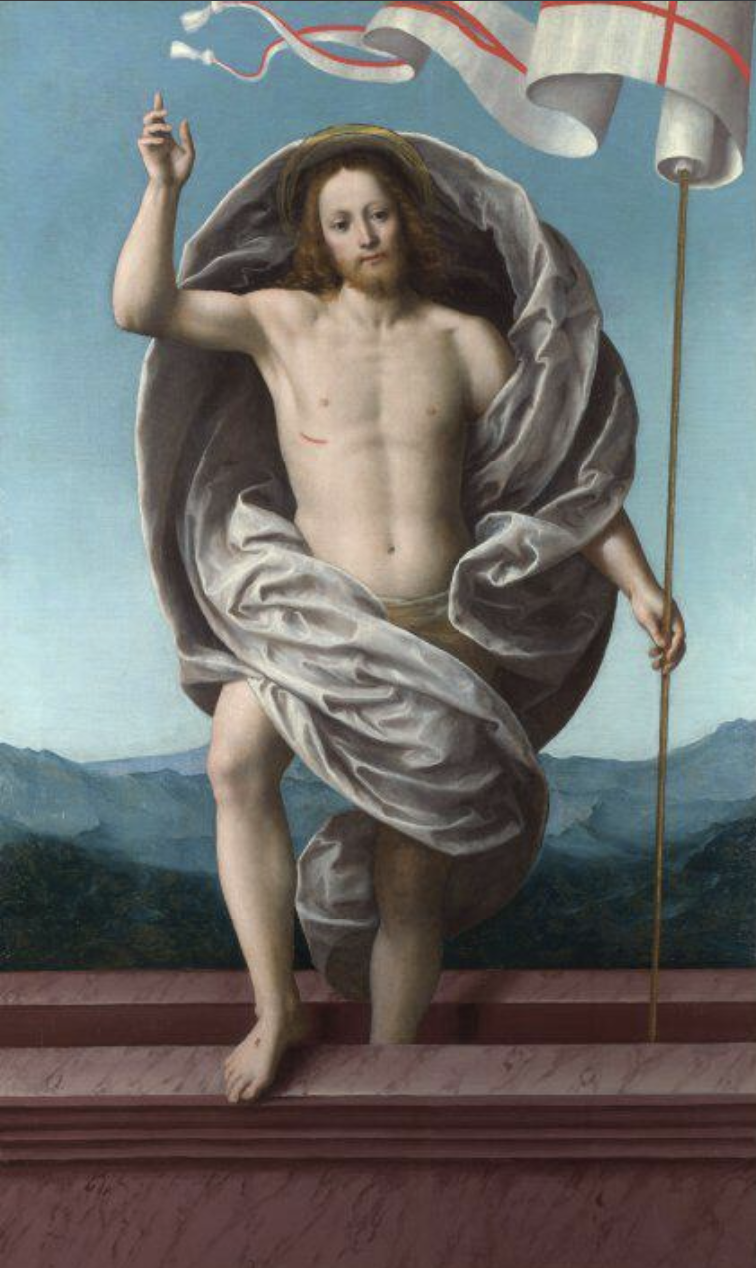
Christ Rising From the Tomb
GAUDENZIO FERRARI
Rising from his open tomb, Christ stands firm, looking down on us and pointing towards heaven. His burial shroud billows around him like a halo of holy light and his tenant bears the cross of St. George. It is a work of victory, commemorating Christ’s victory over death, and a testament to his place beside God. In each brushstroke is a sense of defiance and power, Ferrari considered every element of Christ’s appearance to contribute towards a sense of triumph, and to place the viewer in a lowly position. Originally the central part of an altar piece, and significant in it’s scale; seen in situ, the work would speak to the power of Christ, dwarfing the viewer below it as he rises from a mortal place of death to become a warrior of eternity.
GAUDENZIO FERRARI
GAUDENZIO FERRARI, c.1540. OIL ON POPLAR.
Rising from his open tomb, Christ stands firm, looking down on us and pointing towards heaven. His burial shroud billows around him like a halo of holy light and his tenant bears the cross of St. George. It is a work of victory, commemorating Christ’s victory over death, and a testament to his place beside God. In each brushstroke is a sense of defiance and power, Ferrari considered every element of Christ’s appearance to contribute towards a sense of triumph, and to place the viewer in a lowly position. Originally the central part of an altar piece, and significant in it’s scale; seen in situ, the work would speak to the power of Christ, dwarfing the viewer below it as he rises from a mortal place of death to become a warrior of eternity.