
From Cynicism to Sincerity
Noah Gabriel Martin January 27, 2026
The key feature of what I’ll call the 90s West Coast slacker accent is that the tone dips at the end of a phrase, like an inverse question…
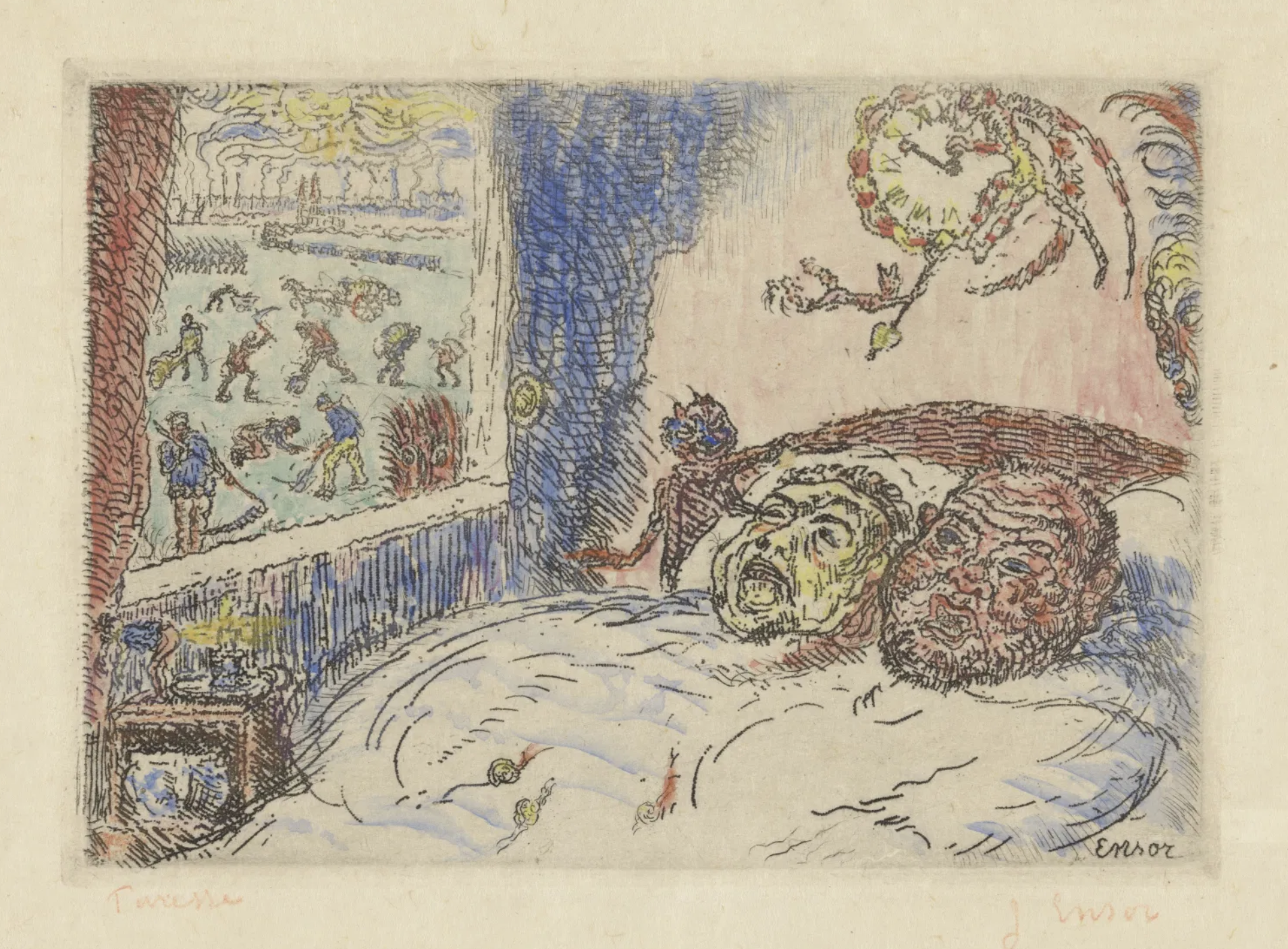
Sloth, James Esnor. 1904.
Noah Gabriel Martin January 27, 2026
The key feature of what I’ll call the 90s West Coast slacker accent is that the tone dips at the end of a phrase, like an inverse question. It doesn’t indicate conviction, however. Instead, the slacker tone is all about ironic detachment; it allows the speaker to say something while signalling that they don’t care about saying it, each claim a candy wrapper thoughtlessly dropped to the floor as they keep on walking.
The purpose of the slacker tone is to distance the speaker from what they’re saying, to show that they can’t be found in their words, that the things they say can’t be used to identify them, who they are, or how they feel. The arc of the pitch descends just as each sentence concludes, like a slash crossing it out as it tumbles off their tongue.
That’s not to say that what they’ve said isn’t true, or even that they don’t believe what they’re saying, just that what they’ve said doesn’t matter to them, and the fact that they’ve said it shouldn’t be taken to mean that that’s how they feel. In short, the slacker tone is a disclaimer that alienates sincerity.
Why say things if they don’t care about them? It’s a puzzle, but the greater mystery is why a whole generation might adopt a tone of voice contrived to undercut each expression, signaling that the things we say are of no importance and shouldn’t be taken seriously. What would motivate us to systematically undermine the power of our own speech?
The slacker tone of voice has frequently been conflated with sarcasm. In fact, the quintessential example of slacker voice is from a 1996 episode of the Simpsons - one punk says “Are you being sarcastic, dude?” to another, who responds “I don't even know anymore.” He doesn’t know, because he hasn’t decided to be sarcastic; to reject as false and even worthy of ridicule the position he’s aping. The slacker voice is more ambiguous than sarcasm, it doesn’t reject the thing being said, thereby actually taking an affirmative position contrary to it; it refuses to take any position at all. If sarcasm announces, with ridicule, that you don’t agree with the semantic content of what you’re saying, a slacker tone makes it impossible to tell what you believe in, or if you believe in anything at all.
The Simpsons’ calling attention to this voice is a distraction from the fact that this snark was the entire style of The Simpsons; the undecided, un-pin-downable position which disowns everything and affirms nothing was characteristic of its era, and The Simpson epitomised it. It treated the mainstream with irreverence, without actually taking up a position against it. It dismissed all seriousness as equally ridiculous, refusing to look at whether some positions might be more worthwhile than others.
The Marxist cultural critic Frederic Jameson, called this style of speech ‘pastiche’, and it was marked by a refusal to sign onto any political project and fight for it. He identified it with a postmodern rejection of commitment to the truth and value of any political cause. Jameson described the kind of parody that isn’t motivated by belief in something, exactly the kind of parody we see in The Simpsons, as ‘parody without a vocation’ or ‘parody with no target’ and nothing to defend. “It is a neutral practice of such mimicry”, he said, “without any of parody’s ulterior motives, amputated of the satiric impulse, devoid of laughter and of any conviction that alongside the abnormal tongue you have momentarily borrowed, some healthy linguistic normality still exists.”
Growing up as a precociously jaded teenager on the Westcoast, the freewheeling, mainstream, equal opportunity cynicism of The Simpsons was exciting. Maybe we didn’t need a programme; maybe it was enough to satirically lay waste to the corrupt pieties of earlier generations. I didn’t think the onus was on us to replace it with a platform of our own. In fact any positive ambition seemed arrogant; indulgence in the hubristic naivety of thinking you’ve got all the answers. The important thing didn’t seem to be to change things, the important thing was not to fall for the bullshit.
“The fear of being a dupe makes us stupid, because it gets in the way of our sensitivity to differences between more and less dangerous errors.”
What I didn’t understand then was how well this callow nihilism plays into the hands of the status quo. Established power is victorious by default, and the fight against it is an uphill battle. All that’s necessary for those in power to maintain their privilege is for nothing to change, they have inertia on their side. Cynicism, scepticism, and nihilism, even if it takes swipes at the status quo, always ultimately reinforces it.
To have a chance, the side of change needs to offer something. It’s not enough to destroy. To become real, the will to change must create.
That’s why, far from bringing down the system, the snarkiness of the 90s could only engender nastier and nastier iterations, from Family Guy to the Pepe and Soyjak memes on 4chan and 8kun image boards. Because it eschewed sincerity as “cringey” from the start, this caustic sense of humour could never give rise to hope. However, it could curdle into a politics that used jokes to conceal a very real lust for the free expression of cruelty and hatred.
90s slacker indifference also served a deeper political and social need: ego defense. Its linguistic detachment is there to protect the speaker. But to protect against what? What could pose so general a threat that any sincerity, no matter how righteous, would leave one open to it.
The American Pragmatist philosopher William James criticised undue skepticism as the ‘fear of being a dupe’.
The problem, according to James, with the ‘fear of being a dupe’, or what most philosophers would call ‘epistemological responsibility’, is that trying to make sure we never fall into error gets in the way of a tremendous amount of learning, discovery, and even of finding truth. Many of the most urgent and momentous questions we face in life - whether and who to marry, what career to pursue - cannot be decided one way or the other, so we frequently find ourselves in a position of having to take leaps of faith, or to put it more ecumenically, to form beliefs and make choices on insufficient grounds. To do that, we’ve got to let go of the fear of error, lest we remain paralysed by it.
The fear of error, in James’ interpretation, is a kind of phobia. It might be understood as a sort of psychosocial autoimmune disorder, and like any autoimmune disorders, it’s a dysfunction in our self-defenses that not only directly harms us, but makes it hard for us to protect ourselves when we have to. Fear of error produces a kind of autonomic stupidity that destroys the body and mind’s ability to distinguish between what’s harmless and real threats.
The fear of being a dupe makes us stupid, because it gets in the way of our sensitivity to differences between more and less dangerous errors. Not all errors are equally dangerous; an unjustified belief in the stability of nuclear détente is more dangerous than an unjustified belief in the benefit of community, but if we’re overly concerned with avoiding any error at all, it makes it a lot harder to appreciate the difference.
The detachment of the slacker tone is a similar kind of disordered autoimmune response, motivated by an even more fundamental paranoia than James’ ‘fear of being a dupe’ - an abject terror of vulnerability. For the paranoid, the problem with being a dupe isn’t really the error, it’s that one has failed to defend oneself, allowed oneself to be taken advantage of, made oneself vulnerable. Besides being a dupe, there are many other ways of being vulnerable, and we have learned to avoid them all.
The terror of vulnerability, like the fear of being a dupe, is paranoid; it’s got nothing whatever to do with any particular threat. It mistakes defensiveness itself for the point, forgetting that defense should be defense of or against something. As Robert Frost writes:
“Before I built a wall I’d ask to know
What I was walling in or walling out,”
If we’ve always got our defenses up, there’s no way for us to peek over the parapets to tell if there’s actually something out there to defend against.
It’s this terror of vulnerability that lay beneath the Simpsons’ snark, and 90s slacker culture in general. On the face of it, this kind of detachment might look cool, but when we look under the hood we can see the shaking, timid reality that it’s covering up.
What culture needs instead is the courage to be sincere, to stand up for something, to risk the vulnerability it takes to say clearly, with care and feeling: “this is what I believe in.”
Dr. Noah Gabriel Martin lectures in philosophy at the University of Winchester and runs the College of Modern Anxiety, a social enterprise that promotes lifelong learning for liberation. He recently began to study dance, which has taught him a lot about being an absolute beginner.
Film
<div style="padding:45% 0 0 0;position:relative;"><iframe src="https://player.vimeo.com/video/1158649931?title=0&byline=0&portrait=0&badge=0&autopause=0&player_id=0&app_id=58479" frameborder="0" allow="autoplay; fullscreen; picture-in-picture; clipboard-write; encrypted-media; web-share" referrerpolicy="strict-origin-when-cross-origin" style="position:absolute;top:0;left:0;width:100%;height:100%;" title="Grand Prix clip 3"></iframe></div><script src="https://player.vimeo.com/api/player.js"></script>
Iggy Pop Playlist
Iggy Confidential
Archival - April 13, 2025
Iggy Pop is an American singer, songwriter, musician, record producer, and actor. Since forming The Stooges in 1967, Iggy’s career has spanned decades and genres. Having paved the way for ‘70’s punk and ‘90’s grunge, he is often considered “The Godfather of Punk.”
Film
<div style="padding:73.02% 0 0 0;position:relative;"><iframe src="https://player.vimeo.com/video/1158649316?badge=0&autopause=0&player_id=0&app_id=58479" frameborder="0" allow="autoplay; fullscreen; picture-in-picture; clipboard-write; encrypted-media; web-share" referrerpolicy="strict-origin-when-cross-origin" style="position:absolute;top:0;left:0;width:100%;height:100%;" title="Stagecoach clip 1"></iframe></div><script src="https://player.vimeo.com/api/player.js"></script>
12 No (Evil) - The I Ching
Chris Gabriel January 24, 2026
In a den of thieves, even a Sage won’t thrive…
Chris Gabriel January 24, 2026
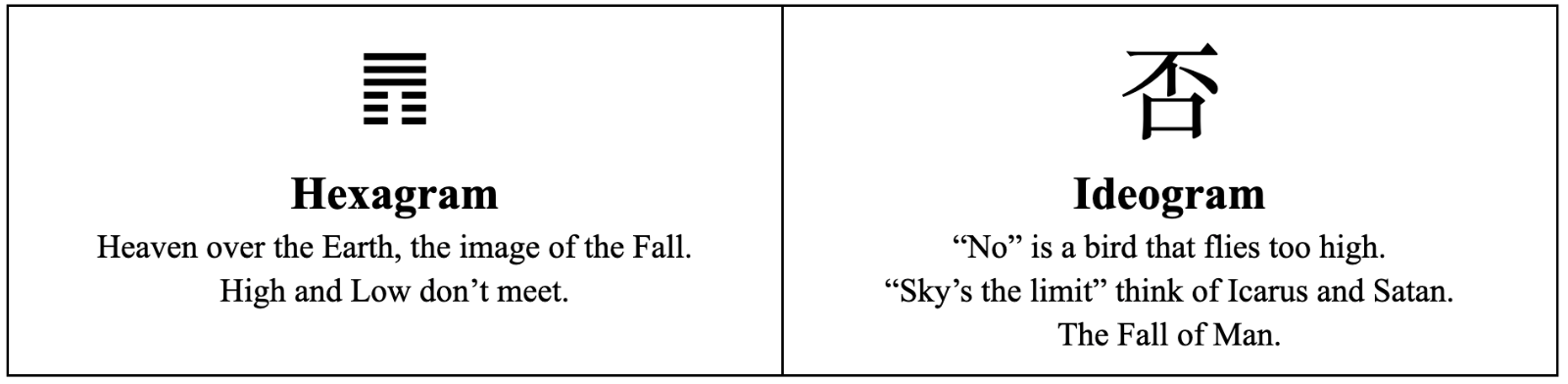
Judgment
In a den of thieves, even a Sage won’t thrive. The High has gone, the Low is here.
Lines
1
Pull up the tares and the wheat goes with it.
2
Accept help. It’s good for little people and bad for the great.
3
Accept shame.
4
Accept commandments. Be with your people.
5
Evil is resting. He’s gone! He’s gone! Tied up in the roots of the tree.
6
Evil is fallen. Evil is past, good is here.
Qabalah
“Kether is in Malkuth”
The Ten of Wands and the Ten of Swords
In this Hexagram we are given the image of the Fall itself. The Paradise of our previous Hexagram has returned to the “natural state” where Heaven is firmly above, and Earth is firmly below. The ideogram is the word for “No” and meant “Evil” in the past. A perfect balance to the affirmative “Good” of the previous hexagram;. the image of a thing falling. The text tells us what to do in this fallen state.
The Judgment directly quotes Christ in Matthew 21:13 “My house shall be called the house of prayer; but ye have made it a den of thieves. The Holy place has been desecrated, the Divine has left it.
1. The first line is identical to 11’s first line. Previously, one could not uproot weeds without endangering Paradise, here the warning holds. We can’t throw the baby out with the bathwater. Even when times are bad, goodness grows.
2. When we are in a bad state, it is good to receive help. This is not the case for those in power. Think of the banks who were bailed out in 2008 while the people suffered.
3. We must accept our condition if we are to improve it. As they often say in 12 step programs “The first step is admitting you have a problem.”
4. When Moses found chaos in his people, he was drawn up to Mount Sinai by God and given the Ten Commandments to bring order to them. In the chaotic fallen state, we need rules and morals to improve our condition.
5. Just as Odin binds Loki in the roots of the World Tree, in Revelation 20 an Angel binds the Devil in chains:
1 And I saw an angel come down from heaven, having the key of the bottomless pit and a great chain in his hand. 2 And he laid hold on the dragon, that old serpent, which is the Devil, and Satan, and bound him a thousand years,
6. As the 11th hexagram ends with a negative fall beginning, this hexagram ends with a “positive fall”: the Fall of Satan., We can place this in a relative temporal sense (for just as in the I Ching, celestial Biblical events are cyclical, not linear) to Luke 10:18:
And he said unto them, I beheld Satan as lightning fall from heaven.
Satan falls because Christ gives a power greater than the devil’s to his followers.
Qabalistically, we see the divine in the material world, but it suffers. The tarot cards for this hexagram are the Ten of Wands and Swords, Oppression and Ruin. The high struggling in the low.
Even in a fallen state, we can understand our time and make the best of it, readying ourselves to improve the world around us. No matter how bad a time feels, we can know with certainty that it will pass, and ready ourselves for the next time.
Film
<div style="padding:75.21% 0 0 0;position:relative;"><iframe src="https://player.vimeo.com/video/1157338979?badge=0&autopause=0&player_id=0&app_id=58479" frameborder="0" allow="autoplay; fullscreen; picture-in-picture; clipboard-write; encrypted-media; web-share" referrerpolicy="strict-origin-when-cross-origin" style="position:absolute;top:0;left:0;width:100%;height:100%;" title="Footlight Parade clip 1"></iframe></div><script src="https://player.vimeo.com/api/player.js"></script>
The Soul of the Word (1963)
Marian Zazeela January 22, 2026
If I choose to inscribe a word I begin in the center of the page. The word first written is awkward and leans a little to the left.
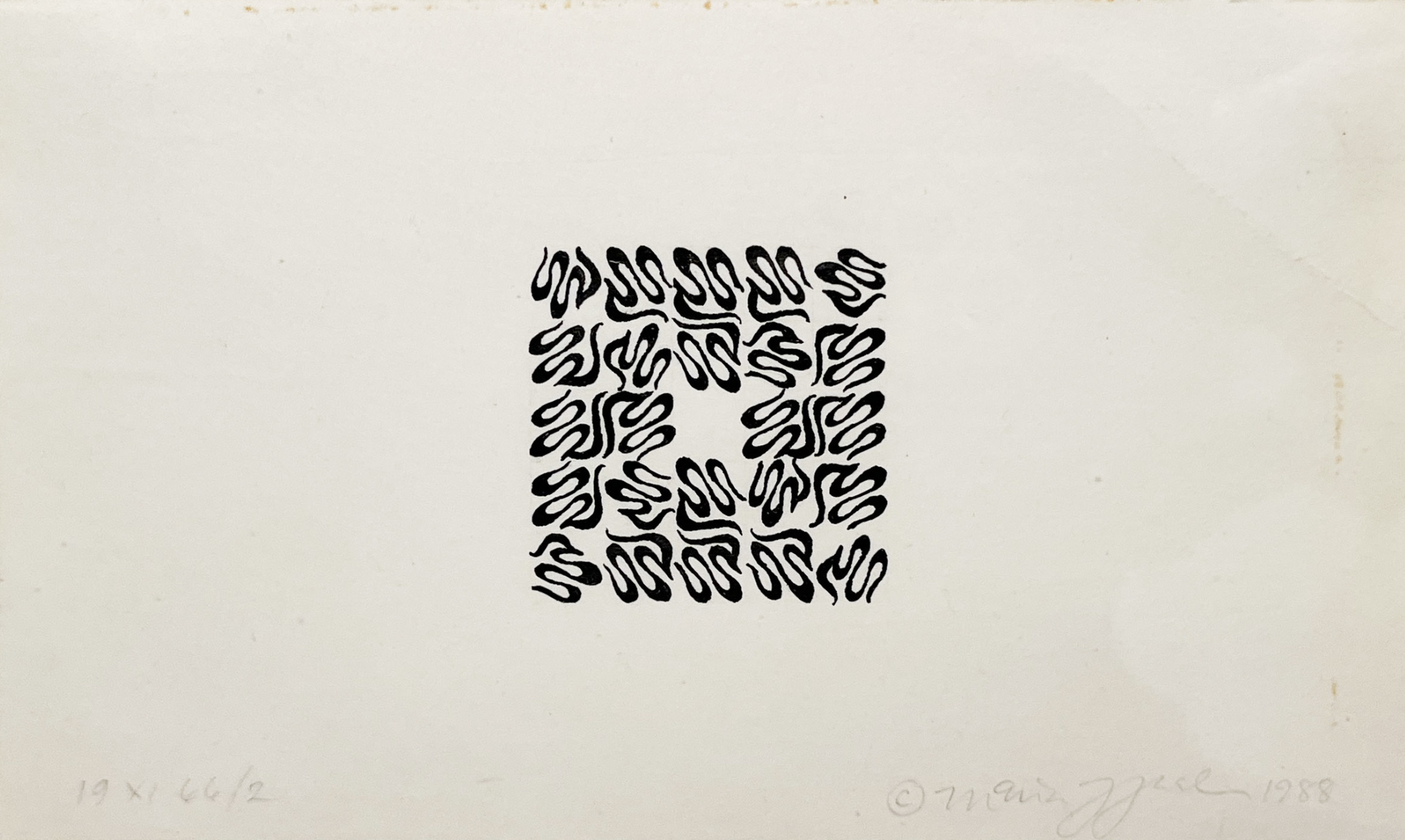
19 XI 66/2, Marian Zazeela.1966.
Marian Zazeela is most known, and her work most often experienced, through her collaborative works with her husband, the composer LaMonte Young. Her light sculptures, album art works, and graphic design work defined the visual and environmental language of 60s downtown New York, but her work as solo artist has long been overlooked, especially her calligraphic creations. In this short essay, first published in the legendary Aspen Magazine in 1971 but written nearly a decade prior, she described her process of making letters. For Zazeela, the letter is a living thing that she breathes life into through her nib. It contorts on the page, following some unknowable natural order for which she can only act as a vessel for facilitation.
Marian Zazeela January 22, 2026
If I choose to inscribe a word I begin in the center of the page. The word first written is awkward and leans a little to the left. I go over the letters adding characteristic curves, making the lines heavier. The letters grow larger, extend curled tentacles out toward each other, begin rubbing and burying their shoots in each other. I move the pen from left to right adding ornaments. The word begins to act as a single unit. Repeated strokes perform continual changes as the letters shift and grow.
The word is still discernible. A sweeping ornament is fastened to the first letter which is now perfect and needs no adjustment.
Now the end letter must have a flourish giving the extra length needed to be exactly centered. Some of the letters have sent wriggling lines beneath them and the balance again requires correction compensation. The word has now spread out of its letters. The letters are more and more obscured as the writing takes precedence. The word no longer matters; it can be spoken.
But the writhing rising out of the word is a dragon devouring itself. Like a cat cleaning her fur the tongue of the word licks its scales with flame and the body of the word ignites and takes the shape of its destruction, which must be perfect and lie perfectly still in the center of the page. if it happens, as it sometimes has, that the flames are not satisfied by the assumption of the word alone, and continue to writhe and curl then the soul of the word is imprisoned and must be set free. And the flames must be slowly brought to the edge of the page where the cool sea waters will soothe them and let them rest. When the fires die out and only the record of flame remains the soul of the word will be carried out to sea and be born again in a raindrop. While it falls to earth in this form it perceives everything through the distorted lens of water; then as it hits the ground all these preconceptions shatter.
But soon the soul of the word is dried and warmed by the sun and feeling drowsy, falls asleep. Upon waking it recalls two dreams: the first, a dream of its future life, tells of the great height it will reach as the soul of a word highly respected by the people, upon whose tongues it will be carried into the richest courts in the world and gently whispered to the ears of noble men and beautiful women; the second dream is the story of its past life but it does not recognize itself in its previous form. Several lives later the dream recurs. Several dreams later the life recurs.
Marian Zazeela (1940 – 2024) was an American light artist, designer, calligrapher, painter, and musician.
Film
<div style="padding:56.25% 0 0 0;position:relative;"><iframe src="https://player.vimeo.com/video/1157328866?badge=0&autopause=0&player_id=0&app_id=58479" frameborder="0" allow="autoplay; fullscreen; picture-in-picture; clipboard-write; encrypted-media; web-share" referrerpolicy="strict-origin-when-cross-origin" style="position:absolute;top:0;left:0;width:100%;height:100%;" title="Acting Shakespeare - Using the Verse clip 5"></iframe></div><script src="https://player.vimeo.com/api/player.js"></script>

Barry Diller
1h 2m
1.21.26
In this clip, Rick speaks with Barry Diller about maintaining instinctual innocence through experience.
<iframe width="100%" height="265" src="https://clyp.it/33l5ursh/widget?token=fcbb6f4b3b0a44d9cee829ea8342b6d2" frameborder="0"></iframe>

Film
<div style="padding:77.25% 0 0 0;position:relative;"><iframe src="https://player.vimeo.com/video/1157282551?badge=0&autopause=0&player_id=0&app_id=58479" frameborder="0" allow="autoplay; fullscreen; picture-in-picture; clipboard-write; encrypted-media; web-share" referrerpolicy="strict-origin-when-cross-origin" style="position:absolute;top:0;left:0;width:100%;height:100%;" title="A Page of Madness clip 1"></iframe></div><script src="https://player.vimeo.com/api/player.js"></script>
Becoming Las Vegas
Jordan Poletti January 20, 2026
If you take the raised pedestrian bridge from the Statue of Liberty, over the 8 Lane Freeway, with the Arthurian Castle on your right, you will find yourself, after being handed a number of call cards for limo-drivers, sex workers and magicians, in the M&M World of Las Vegas Boulevard…
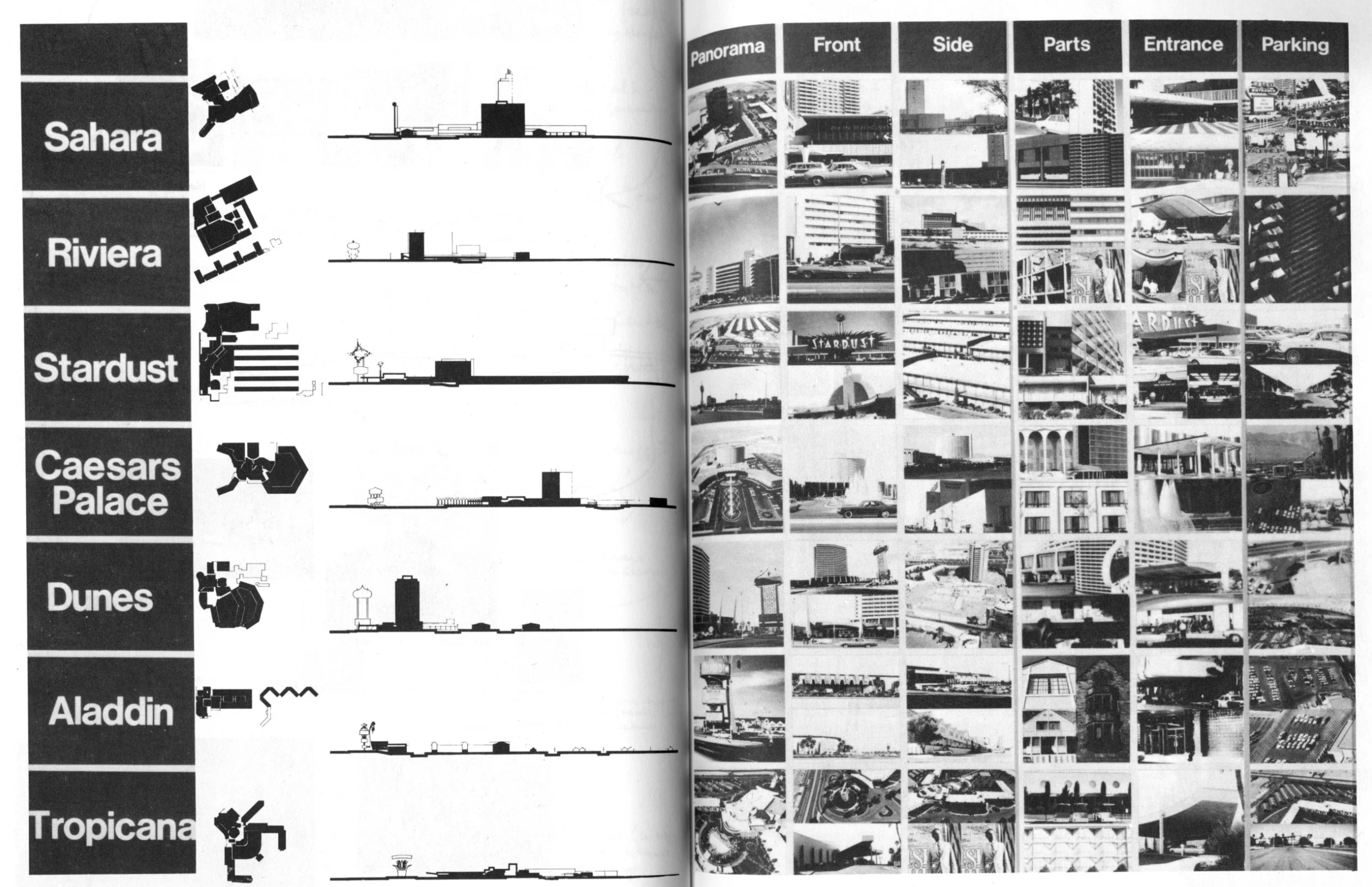
Learning From Las Vegas, Venturi, Brown, Izenous. 1977.
Jordan Poletti January 20, 2026
If you take the raised pedestrian bridge from the Statue of Liberty, over the 8 Lane Freeway, with the Arthurian Castle on your right, you will find yourself, after being handed a number of call cards for limo-drivers, sex workers and magicians, in the M&M World of Las Vegas Boulevard. Nestled neatly into the facade of the MGM Grand, right next to the world's second largest nightclub, owned and operated by a high-end Asian Fusion franchise, it is near identical to the many M&M worlds across the world. If you don't think about it for too long you can make yourself believe you are in Leicester Square, Times Square or Shanghai's People's Square. You wouldn't do this, however, because there is no place in the world you would rather be than right here, the centre of everything and nothingness and very little in between. As you walk through this temple of sugar coated chocolate, peanuts and wafer respectively, you will find yourself no longer in view of the entrance from which you arrived and as you stumble past a 10 foot tube of green candy, you will feel the soft patterned carpet of the MGM Grand Casino. Immediately your tiredness will lift as you breath in oxygenated air and are embraced by the warmth of cigarette smoke and blue-light, epileptic digital screens and the faint click-clack of a roulette ball. If you wanted to return to the M&M world you could not, because the exit has disappeared and it is a one-way porthole that serves a single destination. You will pay a 20 dollar ATM charge to take out not enough money and you will ask yourself the same question that Gorgias, Lao Zing, Descartes, Einstein, David Byrne and Little Simz have asked before you - how did I get here?
If you do not like to gamble, you may well go your whole life without ever visiting Las Vegas. If you do like to gamble, you should go your whole life without ever visiting Las Vegas. But if you have any interest in America, by which I mean modernity, then it is the most important place on Earth. Since its 20th century inception, it has been a city of popular and academic lore, used as muse and message for sin, singularity and separation. A false city who's skyline, Tom Wolfe once wrote, is made up not of buildings or mountains but signage. For the first 100 years of its existence, I suspect the mythification of Las Vegas came from its singularity and its otherness. A city built for a singular purpose of pleasure fulfilment, Versailles it's only equal, and the only legal destination of satiating an American desire for economic self-flagellation. When you arrived on the Strip for 100 years, you encountered novelty, a mirage of simulation and simulacra. Baudrillard's treatise needed no other examples that Las Vegas itself, though only in his later years did he begin to take the city as seriously as he should have. It was Chris Kraus, in her infinite prescience who organised the Chance Conference with Baudrillard in the Nevada desert, placing the father of hyper-modernity in the belly of his patricidal son. It was, he said, and architects, theorist and critics before him, a prototype of the world to come. It's designed disorientation of brash patterns and labyrinthine interiors a far cry from a world still holding onto an enlightenment structure of order and reality. As its neon farms and mob-owned tables were replaced by Eiffel Towers, Pyramids, Gondolas and conglomerates, Las Vegas continued to exist as separate from the rest of the world, updating and adapting to retain its otherness. Where Baudrillard called Disney Land 'miniaturised pleasure of real America', Las Vegas was the miniaturised pleasure of the imaged world. It existed beyond America, a universe unto itself, no longer representing a world but becoming one. It was the only true place in the world, because it cared not for truth, showed there was no truth in the first place, only belief. It offered something separate from daily existence, and this is what gave it its power.
Yet as you stand in the MGM Grand, a bag of M&Ms in your hand, there is little novelty. It feels strangely familiar. You did not get lost on your way here because somehow, the labyrinths of the city felt like you had walked them a hundred times, that the roadmap was embedded in you. This is because the world has caught up with Las Vegas, nearly 100 years later. When Nixon removed the dollar from the Gold Standard in 1971, he made money a simulacra, that which points only to itself, Las Vegas sighed, as it had been doing the same since 1931. Now, it is not just money which is the simulacra but the hyper-reality than Baudrillard talked about has taken is in full force, and Vegas was waiting. On a single junction, outside the M&M world, you can travel through space and time, every corner of the globe and time-period of history. The Statue of Liberty, the Pyramids of Giza, the Eiffel Tower, Caesar's Palace, Medieval Castles. It is no coincidence that the hotels of Vegas are always pointing to something else. They're taking us out of space and time, to a plane not inhabited by context, but a flat circle of shamelessness and instinct. Yet now, this Junction that was once the property of the Nevada desert, exists in the right hand pocket of near ever pair of trousers in the world. We scroll through our feeds and move through time and space. We see a model under the Eiffel Tower and right below it, an aunt by the Sphinx. Between the personal experience we are served ads for hard shell chocolates and pop- ups for daily spins that promise the potential of riches. Brown, Izenour and Venturi told us we must learn from Las Vegas, but instead we have become it. The city understood, long before the rest of the world, that space and time are redundant in the face of desire and satiation. It is the external facade of hyper-reality, of the dissolving of era, country, reality, into a single falsity all while you are crossing that pedestrian bridge above a six lane highway. This is where we are all right now, wavering on the precipice of the M&M World and the Casino beyond it. And we haven't even got inside to gamble yet.
Jordan Poletti is a writer and researcher, focusing on 20th century cultural theory and philosophy.
Film
<div style="padding:56.25% 0 0 0;position:relative;"><iframe src="https://player.vimeo.com/video/1157279293?badge=0&autopause=0&player_id=0&app_id=58479" frameborder="0" allow="autoplay; fullscreen; picture-in-picture; clipboard-write; encrypted-media; web-share" referrerpolicy="strict-origin-when-cross-origin" style="position:absolute;top:0;left:0;width:100%;height:100%;" title="Bridge to Space clip 1"></iframe></div><script src="https://player.vimeo.com/api/player.js"></script>
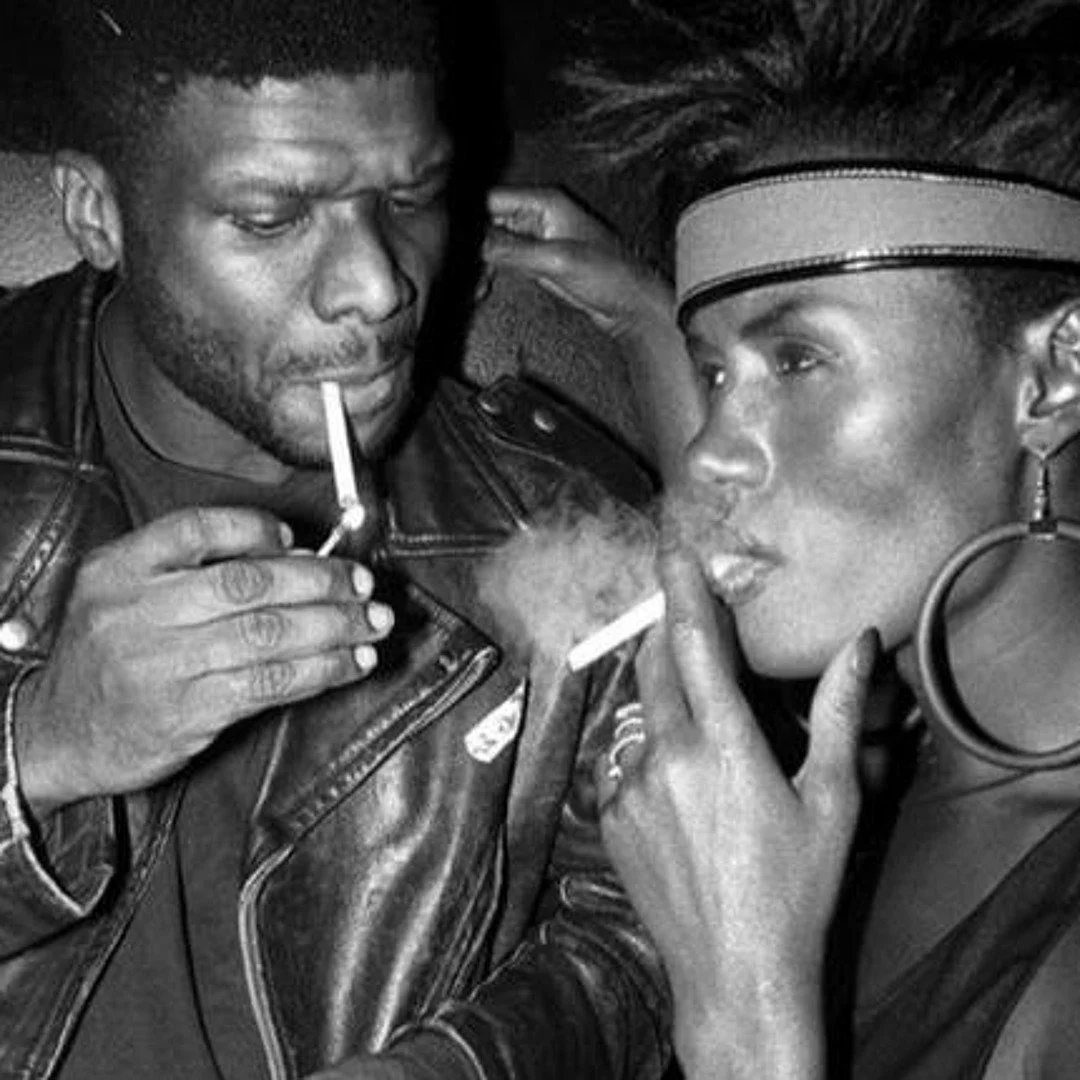
Larry Levan Playlist
Archival 1967-1987
Larry Levan was an influential American DJ who defined what modern dance clubs are today. He is most widely renowned for his long-time residency at Paradise Garage, also known as “Gay-Rage”, a former nightclub at 84 King Street in Manhattan, NY.
Film
<div style="padding:56.25% 0 0 0;position:relative;"><iframe src="https://player.vimeo.com/video/1155742722?badge=0&autopause=0&player_id=0&app_id=58479" frameborder="0" allow="autoplay; fullscreen; picture-in-picture; clipboard-write; encrypted-media; web-share" referrerpolicy="strict-origin-when-cross-origin" style="position:absolute;top:0;left:0;width:100%;height:100%;" title="Filming Othello clip 1"></iframe></div><script src="https://player.vimeo.com/api/player.js"></script>
11 Yes (Good) - The I Ching
Chris Gabriel January 17, 2026
The Low goes and the High comes…
Chris Gabriel January 17, 2026
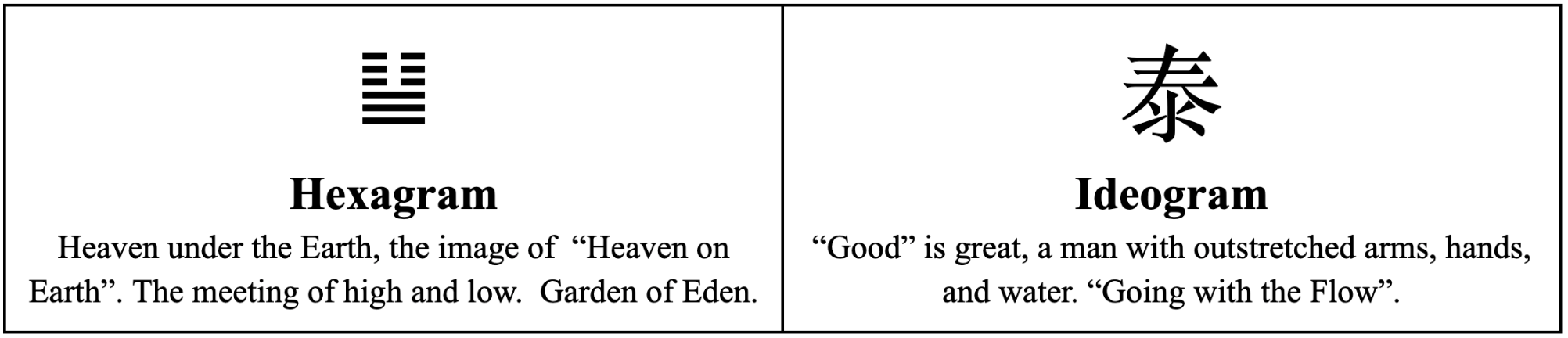
Judgment
The Low goes and the High comes.
Lines
1
Pull up the tares and the wheat goes with it.
2
Embrace the hard places. Crossing the river, after losing a friend I make it to the middle.
3
Without lows there are no highs. Without going there is no return. It’s tough, but it’s not a problem. Don’t stress. Eat.
4
Fluttering about without wealth. Call on your neighbors, not with demands, but with faith.
5
The Great Emperor marries a commoner.
6
The castle walls have fallen into the moat. No soldiers, so I’ll give my own orders.
Qabalah
“Malkuth is in Kether”
The Ace of Cups and the Ace of Disks.
In this Hexagram, we are once again given an image of something close to the perfection of Heaven: the Prelapsarian World, the Garden of Eden. Unusually here, Heaven, which traditionally remains high, is below the Earth. They are interwoven and unified before the Fall. This is “Heaven on Earth”, but in the text we see that the seeds of decay have been sown, and that this pleasurable condition will not last.
1 The opening line is remarkably close to Christ’s Parable of the Tares in Matthew 13.
29 But he said, Nay; lest while ye gather up the tares, ye root up also the wheat with them.
30 Let both grow together until the harvest: and in the time of harvest I will say to the reapers, Gather ye together first the tares, and bind them in bundles to burn them: but gather the wheat into my barn.
In this line we see the intermingling of the Low and the High, Matter and Spirit, Earth and Heaven. “Et in Arcadia ego” - even in Paradise, evil has been seeded.
2 The condition of material existence necessitates our affirmation of difficulty. We must find the balance in any situation.
3 A profoundly Solomonic wisdom, there is a time for every thing. One could say the I Ching itself is the “clock” that indicates what sort of “time” it is. As for the affirmation at the end, it is a direct mirror to Solomon’s words in Ecclesiastes 9:7 :
Go thy way, eat thy bread with joy, and drink thy wine with a merry heart; for God now accepteth thy works.
4 As in previous hexagrams, we get by with a little help from our friends.
5 In a way, this is another image of the High and Low coming together - the union of the Holy Spirit and Mary, the Divine and the Mundane marrying.
6 By the final line, the condition has decayed. The divine structure has fallen, and individuals must take hold of their own fate.
Qabalistically, this Hexagram illustrates the axiom “Malkuth is in Kether”, base matter exists within the Divine. Before the Fall, God was interwoven with the world. It is the nature of things to change, and accordingly this state of Paradise could never last. Though the state is finite, the hexagram affirms that it does return time after time.
Hannah Peel Playlist
Archival - December 17, 2025
Mercury Prize, Ivor Novello and Emmy-nominated, RTS and Music Producers Guild winning composer, with a flow of solo albums and collaborative releases, Hannah Peel joins the dots between science, nature and the creative arts, through her explorative approach to electronic, classical and traditional music.
Holy Face (1929)
Aldous Huxley January 15, 2026
Good Times are chronic nowadays…
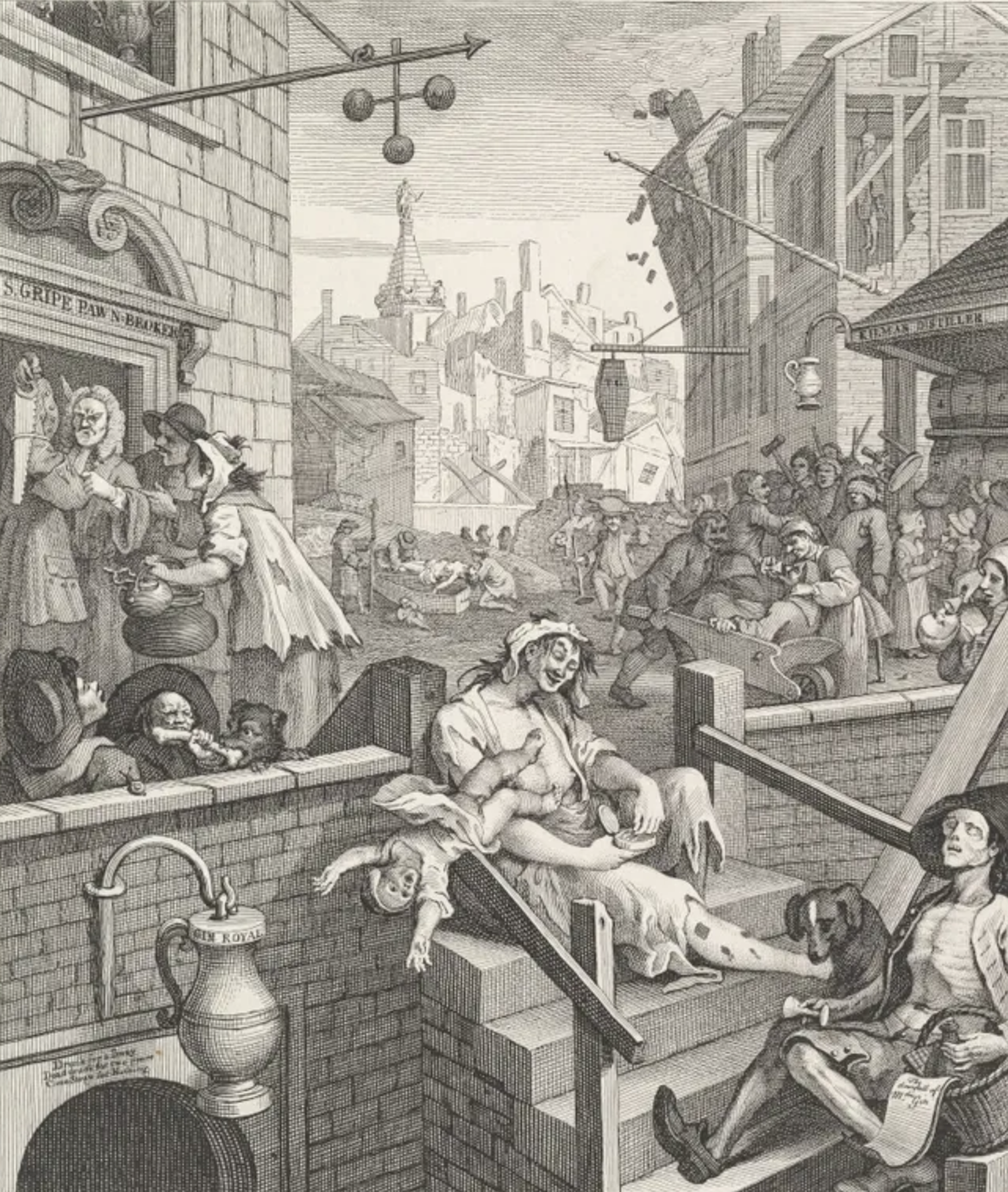
Gin Lane, William Hogarth. 1751.
Before “Brave New World”, Huxley’s seminal and prescient novel about a dystopian future where citizens willingly blind themselves to injustice in favour of ease, Aldous Huxley wrote this essay and chose it to lead one of his earliest collections of his writings. “Holy Face” is a searing critique of the pleasure seeking society, where boredom has become the enemy of existence and we fill our time with fleeting, superficial pleasure in lieu of meaningful thought. This, he argues, is exactly counter to its aim and our desire for quick thrills only creates a more bored society, that must get cheaper and cheaper pleasure to satiate its desire. Huxley, before so many others, saw the pervasiveness of a spiritual emptiness creep into every facet of existence and tried to, by identify it, urge people to reject the systems put upon them as means of control and instead take the reigns of existence, for all its pains and tribulations, as the route to a higher, better life. He uses the religious festival of the Feast of the Holy Face in Lucca, and the acts of devotion occurring around a wooden crucifix bearing the titular ‘Holy Face’, as an example of how we can find deeper meaning in confronting the uncomfortable and the unsettling. After confronting the Holy Face, people instinctively turn back to sunlight, crowds, noise, and the pleasures of the fair outside the church. Huxley sees this instinctive inconsistency as the wiser response. Ordinary people, by embracing both fear and festivity, embody a deeper, unconscious wisdom of life.
Aldous Huxley January 15, 2026
Good Times are chronic nowadays. There is dancing every afternoon, a continuous performance at all the picture-palaces, a radio concert on tap, like gas or water, at any hour of the day or night. The fine point of seldom pleasure is duly blunted. Feasts must be solemn and rare, or else they cease to be feasts. "Like stones of worth they thinly placed are" (or, at any rate, they were in Shakespeare's day, which was the day of Merry England), "or captain jewels in the carconet." The ghosts of these grand occasional jollifications still haunt our modern year. But the stones of worth are indistinguishable from the loud imitation jewelry which now adorns the entire circlet of days. Gems, when they are too large and too numerous, lose all their precious significance; the treasure of an Indian prince is as unimpressive as Aladdin's cave at the pantomime. Set in the midst of the stage diamonds and rubies of modern pleasure, the old feasts are hardly visible. It is only among more or less completely rustic populations, lacking the means and the opportunity to indulge in the modern chronic Good Time, that the surviving feasts preserve something of their ancient glory. Me personally the unflagging pleasures of contemporary cities leave most lugubriously unamused. The prevailing boredom -- for oh, how desperately bored, in spite of their grim determination to have a Good Time, the majority of pleasure-seekers really are! -- the hopeless weariness, infect me. Among the lights, the alcohol, the hideous jazz noises, and the incessant movement I feel myself sinking into deeper and ever deeper despondency. By comparison with a night-club, churches are positively gay. If ever I want to make merry in public, I go where merry-making is occasional and the merriment, therefore, of genuine quality; I go where feasts come rarely.
For one who would frequent only the occasional festivities, the great difficulty is to be in the right place at the right time. I have traveled through Belgium and found, in little market towns, kermesses that were orgiastic like the merry-making in a Breughel picture. But how to remember the date? And how, remembering it, to be in Flanders again at the appointed time? The problem is almost insoluble. And then there is Frogmore. The nineteenth-century sculpture in the royal mausoleum is reputed to be the most amazing of its amazing kind. I should like to see Frogmore. But the anniversary of Queen Victoria's death is the only day in the year when the temple is open to the public. The old queen died, I believe, in January. But what was the precise date? And, if one enjoys the blessed liberty to be elsewhere, how shall one reconcile oneself to being in England at such a season? Frogmore, it seems, will have to remain unvisited. And there are many other places, many other dates and days, which, alas, I shall always miss. I must even be resignedly content with the few festivities whose times I can remember and whose scene coincides, more or less, with that of my existence in each particular portion of the year.
One of these rare and solemn dates which I happen never to forget is September the thirteenth. It is the feast of the Holy Face of Lucca. And since Lucca is within thirty miles of the seaside place where I spend the summer, and since the middle of September is still serenely and transparently summer by the shores of the Mediterranean, the feast of the Holy Face is counted among the captain jewels of my year. At the religious function and the ensuing fair I am, each September, a regular attendant.
"By the Holy Face of Lucca!" It was William the Conqueror's favorite oath. And if I were in the habit of cursing and swearing, I think it would also be mine. For it is a fine oath, admirable both in form and substance. "By the Holy Face of Lucca!" In whatever language you pronounce them, the words reverberate, they rumble with the rumbling of genuine poetry. And for any one who has ever seen the Holy Face, how pregnant they are with power and magical compulsion! For the Face, the Holy Face of Lucca, is certainly the strangest, the most impressive thing of its kind I have ever seen.
Imagine a huge wooden Christ, larger than life, not naked, as in later representations of the Crucifixion, but dressed in a long tunic, formally fluted with stiff Byzantine folds. The face is not the face of a dead, or dying, or even suffering man. It is the face of a man still violently alive, and the expression of its strong features is stern, is fierce, is even rather sinister. From the dark sockets of polished cedar wood two yellowish tawny eyes, made, apparently, of some precious stone, or perhaps of glass, stare out, slightly squinting, with an unsleeping balefulness. Such is the Holy Face. Tradition affirms it to be a true, contemporary portrait. History establishes the fact that it has been in Lucca for the best part of twelve hundred years. It is said that a rudderless and crewless ship miraculously brought it from Palestine to the beaches of Luni. The inhabitants of Sarzana claimed the sacred flotsam; but the Holy Face did not wish to go to Sarzana. The oxen harnessed to the wagon in which it had been placed were divinely inspired to take the road to Lucca. And at Lucca the Face has remained ever since, working miracles, drawing crowds of pilgrims, protecting and at intervals failing to protect the city of its adoption from harm. Twice a year, at Easter time and on the thirteenth of September, the doors of its little domed tabernacle in the cathedral are thrown open, the candles are lighted, and the dark and formidable image, dressed up for the occasion in a jeweled overall and with a glittering crown on its head, stares down -- with who knows what mysterious menace in its bright squinting eyes? -- on the throng of its worshipers.
The official act of worship is a most handsome function. A little after sunset a procession of clergy forms up in the church of San Frediano. In the ancient darkness of the basilica a few candles light up the liturgical ballet. The stiff embroidered vestments, worn by generations of priests and from which the heads and hands of the present occupants emerge with an air of almost total irrelevance (for it is the sacramental carapace that matters; the little man who momentarily fills it is without significance), move hieratically hither and thither through the rich light and the velvet shadows. Under his baldaquin the jeweled old archbishop is a museum specimen. There is a forest of silvery mitres, spear-shaped against the darkness (bishops seem to be plentiful in Lucca). The choir boys wear lace and scarlet. There is a guard of halberdiers in a gaudily-pied medieval uniform. The ritual charade is solemnly danced through. The procession emerges from the dark church into the twilight of the streets. The municipal band strikes up loud inappropriate music. We hurry off to the cathedral by a short cut to take our places for the function.
“Oh, how desperately bored, in spite of their grim determination to have a Good Time, the majority of pleasure-seekers really are!”
The Holy Face has always had a partiality for music. Yearly, through all these hundreds of years, it has been sung to and played at, it has been treated to symphonies, cantatas, solos on every instrument. During the eighteenth century the most celebrated castrati came from the ends of Italy to warble to it; the most eminent professors of the violin, the flute, the oboe, the trombone scraped and blew before its shrine. Paganini himself, when he was living in Lucca in the court of Elisa Bonaparte, performed at the annual concerts in honor of the Face. Times have changed, and the image must now be content with local talent and a lower standard of musical excellence. True, the good will is always there; the Lucchesi continue to do their musical best; but their best is generally no more nor less than just dully creditable. Not always, however. I shall never forget what happened during my first visit to the Face. The musical program that year was ambitious. There was to be a rendering, by choir and orchestra, of one of those vast oratorios which the clerical musician, Dom Perosi, composes in a strange and rather frightful mixture of the musical idioms of Palestrina, Wagner, and Verdi. The orchestra was enormous; the choir was numbered by the hundred; we waited in pleased anticipation for the music to begin. But when it did begin, what an astounding pandemonium! Everybody played and sang like mad, but without apparently any reference to the playing and singing of anybody else. Of all the musical performances I have ever listened to it was the most Manchester-Liberal, the most Victorian-democratic. The conductor stood in the midst of them waving his arms; but he was only a constitutional monarch -- for show, not use. The performers had revolted against his despotism. Nor had they permitted themselves to be regimented into Prussian uniformity by any soul-destroying excess of rehearsal. Godwin's prophetic vision of a perfectly individualistic concert was here actually realized. The noise was hair-raising. But the performers were making it with so much gusto that, in the end, I was infected by their high spirits and enjoyed the hullabaloo almost as much as they did. That concert was symptomatic of the general anarchy of post-war Italy. Those times are now past. The Fascists have come, bringing order and discipline -- even to the arts. When the Lucchesi play and sing to their Holy Face, they do it now with decorum, in a thoroughly professional and well-drilled manner. It is admirable, but dull. There are times, I must confess, when I regret the loud delirious blaring and bawling of the days of anarchy.
Almost more interesting than the official acts of worship are the unofficial, the private and individual acts. I have spent hours in the cathedral watching the crowd before the shrine. The great church is full from morning till night. Men and women, young and old, they come in their thousands, from the town, from all the country round, to gaze on the authentic image of God. And the image is dark, threatening, and sinister. In the eyes of the worshipers I often detected a certain meditative disquiet. Not unnaturally. For if the face of Providence should really and in truth be like the Holy Face, why, then -- then life is certainly no joke. Anxious to propitiate this rather appalling image of Destiny, the worshipers come pressing up to the shrine to deposit a little offering of silver or nickel and kiss the reliquary proffered to every almsgiver by the attendant priest. For two francs fifty perhaps Fate will be kind. But the Holy Face continues, unmoved, to squint inscrutable menace. Fixed by that sinister regard, and with the smell of incense in his nostrils, the darkness of the church around and above him, the most ordinary man begins to feel himself obscurely a Pascal. Metaphysical gulfs open before him. The mysteries of human destiny, of the future, of the purpose of life oppress and terrify his soul. The church is dark; but in the midst of the darkness is a little island of candlelight. Oh, comfort! But from the heart of the comforting light, incongruously jeweled, the dark face stares with squinting eyes, appalling, balefully mysterious.
But luckily, for those of us who are not Pascal, there is always a remedy. We can always turn our back on the Face, we can always leave the hollow darkness of the church. Outside, the sunlight pours down out of a flawless sky. The streets are full of people in their holiday best. At one of the gates of the city, in an open space beyond the walls, the merry-go-rounds are turning, the steam organs are playing the tunes that were popular four years ago on the other side of the Atlantic, the fat woman's drawers hang unmoving, like a huge forked pennon, in the windless air outside her booth. There is a crowd, a smell, an unceasing noise -- music and shouting, roaring of circus lions, giggling of tickled girls, squealing from the switchback of deliciously frightened girls, laughing and whistling, tooting of cardboard trumpets, cracking of guns in the rifle-range, breaking of crockery, howling of babies, all blended together to form the huge and formless sound of human happiness. Pascal was wise, but wise too consciously, with too consistent a spirituality. For him the Holy Face was always present, haunting him with its dark menace, with the mystery of its baleful eyes. And if ever, in a moment of distraction, he forgot the metaphysical horror of the world and those abysses at his feet, it was with a pang of remorse that he came again to himself, to the self of spiritual consciousness. He thought it right to be haunted, he refused to enjoy the pleasures of the created world, he liked walking among the gulfs. In his excess of conscious wisdom he was mad; for he sacrificed life to principles, to metaphysical abstractions, to the overmuch spirituality which is the negation of existence. He preferred death to life. Incomparably grosser and stupider than Pascal, almost immeasurably his inferiors, the men and women who move with shouting and laughter through the dusty heat of the fair are yet more wise than the philosopher. They are wise with the unconscious wisdom of the species, with the dumb, instinctive, physical wisdom of life itself. For it is life itself that, in the interests of living, commands them to be inconsistent. It is life itself that, having made them obscurely aware of Pascal's gulfs and horrors, bids them turn away from the baleful eyes of the Holy Face, bids them walk out of the dark, hushed, incense-smelling church into the sunlight, into the dust and whirling motion, the sweaty smell and the vast chaotic noise of the fair. It is life itself; and I, for one, have more confidence in the rightness of life than in that of any individual man, even if the man be Pascal.
Aldous Huxley (1894 – 1963) was an English writer and philosopher, widely acknowledged as one of the foremost intellectuals of his time.
Film
<div style="padding:59.82% 0 0 0;position:relative;"><iframe src="https://player.vimeo.com/video/1154456989?badge=0&autopause=0&player_id=0&app_id=58479" frameborder="0" allow="autoplay; fullscreen; picture-in-picture; clipboard-write; encrypted-media; web-share" referrerpolicy="strict-origin-when-cross-origin" style="position:absolute;top:0;left:0;width:100%;height:100%;" title="Purple Noon clip 2"></iframe></div><script src="https://player.vimeo.com/api/player.js"></script>
Joseph Nguyen
1h 4m
1.14.26
In this clip, Rick speaks with Joseph Nguyen about turning fear into a tool for motivation.
<iframe width="100%" height="265" src="https://clyp.it/uemh44g4/widget?token=b741677e0f8eba9f87233f8dc8217d26" frameborder="0"></iframe>
Film
<div style="padding:75% 0 0 0;position:relative;"><iframe src="https://player.vimeo.com/video/1154454527?badge=0&autopause=0&player_id=0&app_id=58479" frameborder="0" allow="autoplay; fullscreen; picture-in-picture; clipboard-write; encrypted-media; web-share" referrerpolicy="strict-origin-when-cross-origin" style="position:absolute;top:0;left:0;width:100%;height:100%;" title="Firing Line clip 10"></iframe></div><script src="https://player.vimeo.com/api/player.js"></script>